
Quick Answer: The best corporate gifts for employees are chosen based on the occasion, your budget, and the recipient’s preferences. Focus on practical, high-quality items that employees will genuinely use while incorporating your branding in a subtle, professional way. A thoughtful gift creates a lasting impression, whereas inexpensive promotional items that feel generic or disposable are far less likely to make employees feel valued.
Most companies give gifts because it feels like the right thing to do. Fewer stop to ask why it works – or why it sometimes doesn’t. The honest answer is that gifting sits at the intersection of recognition, morale, and retention. When someone feels overlooked at work, a well-timed, well-chosen gift is a small but real signal that their contribution registered. When it’s an afterthought, it reads exactly that way, and employees notice the difference immediately.
The stakes are higher than they used to be. Global employee engagement has slipped to around 20 percent worldwide, according to Gallup’s most recent workplace research – the lowest level in years, with disengagement carrying a real economic cost. That backdrop is exactly why small, consistent signals of appreciation matter more than an expensive once-a-year gesture. Hybrid and remote setups have raised the bar further. When a manager can’t drop by someone’s desk to say thanks, a thoughtfully chosen gift becomes one of the few tangible ways to close that distance.
This shows up clearly in how buying behavior has shifted. Interest in corporate gifts Saudi Arabia programs has grown as HR and procurement teams treat gifting as a planned line item rather than a last-minute scramble before a holiday or milestone. This guide walks through how to choose employee gifts that actually fit the people, the moment, and the brand behind them – without wasting budget on items that end up in a drawer.
What Makes a Good Corporate Gift?
Strip away the packaging and the branding, and a good corporate gift comes down to a short list of qualities. It needs to be useful in daily life – not useful in theory, useful in the sense that someone reaches for it without thinking. It should feel a notch above its price tag, which has more to do with finish and presentation than the amount spent. The gift needs to be easy to personalize or brand without looking forced. And it has to fit the culture of the company and the profile of the people receiving it, not just whatever was on sale in bulk.
The best employee gifts quietly do two jobs at once: they make the person feel valued, and they extend the brand in a way that reads as generous rather than promotional. That balance is well documented in workplace culture research on recognition, which consistently ties consistent appreciation – gifts included – to stronger retention and morale. Before locking in a gift, it helps to run it through a short checklist:
- Would the recipient use this without being told to?
- Does it feel intentional at this price point, or does it feel like a placeholder?
- Is the branding tasteful enough that someone would carry it in public?
- Does it suit the occasion – onboarding, anniversary, holiday, milestone – or is it generic enough to apply to anything?
- Would this work across a mixed team, including remote staff and different departments?
Start with the Occasion
The occasion should shape the gift long before budget or branding enters the conversation. A gift that lands well at a holiday party can feel oddly formal at onboarding, and a milestone gift that’s too casual can undersell a genuine achievement.
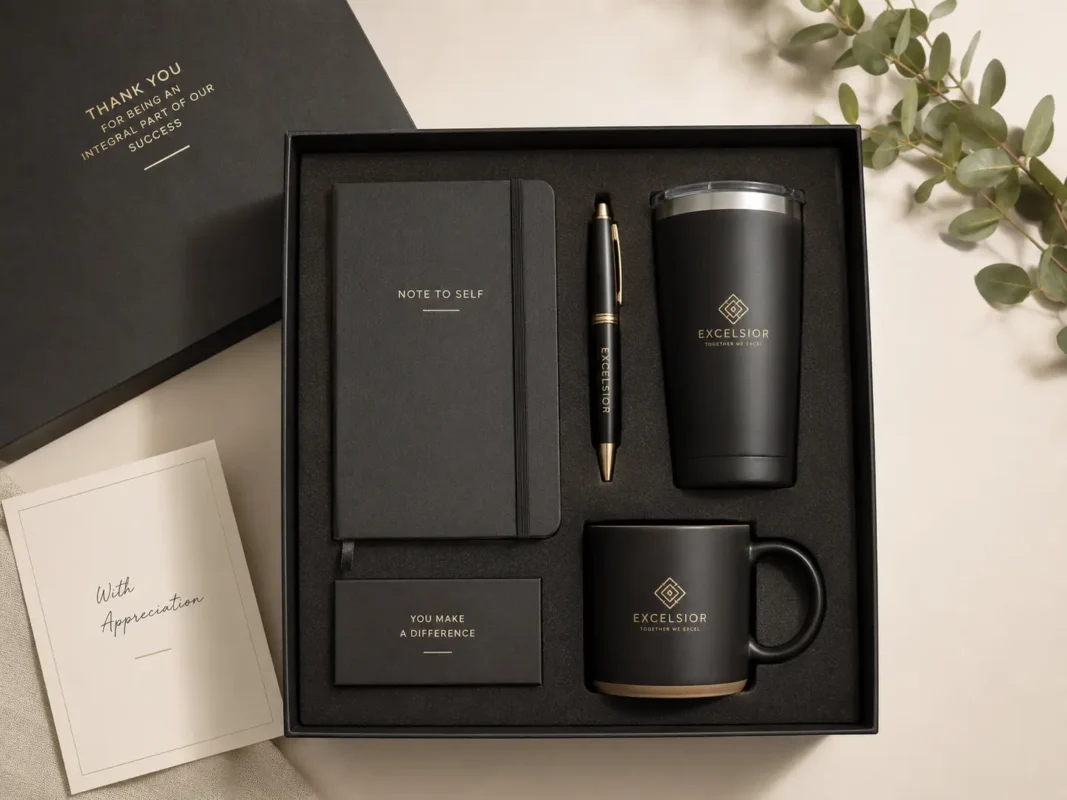
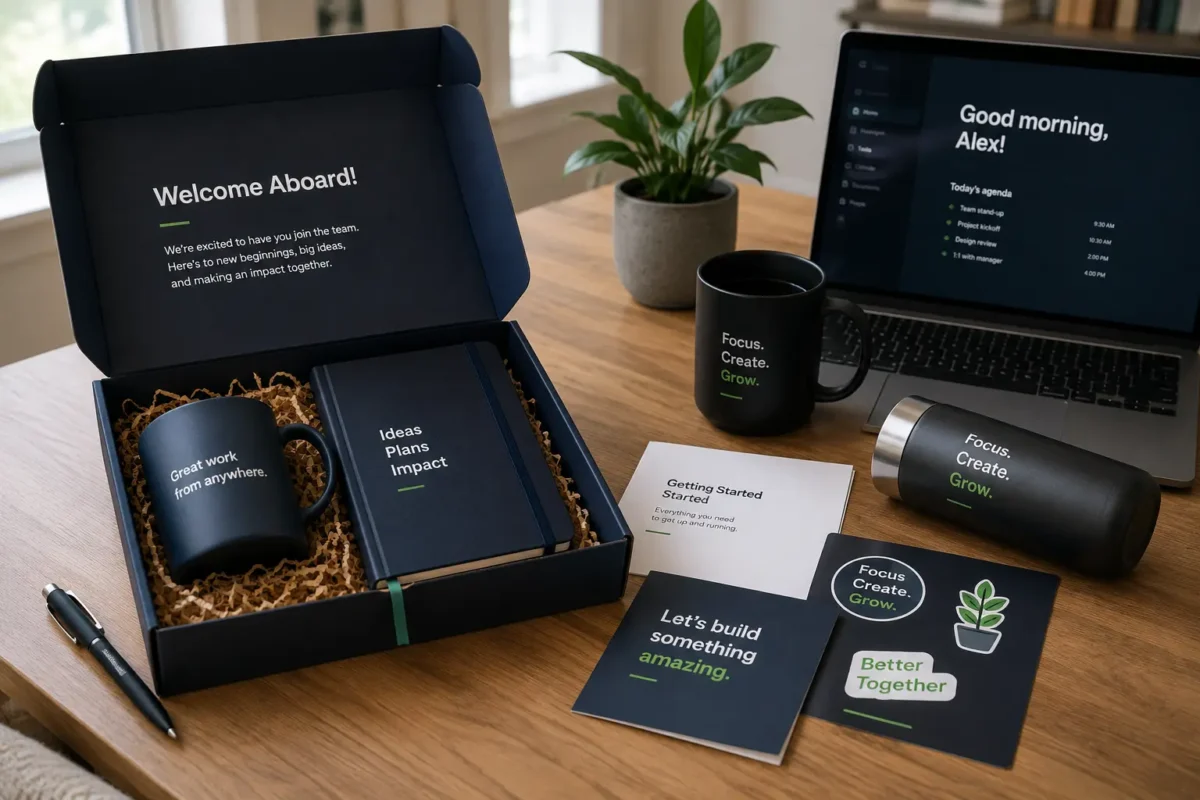
New employee onboarding calls for something welcoming and practical – a notebook, a bottle, or a small curated gift set that says “we planned for you” rather than “we had extras.” Work anniversaries can carry more warmth and a touch more spend, especially at the five- or ten-year mark. Holidays and festive seasons are where most budgets concentrate, which also means they’re where generic gifting is easiest to fall into – worth resisting. Team wins and milestones reward a specific outcome, so the gift can afford to feel more celebratory and less standardized.
Conference giveaways and event gifting answer to a different goal entirely – volume and brand visibility over personal sentiment – so the calculus changes. Remote employee appreciation deserves its own thinking, since shipping logistics and unboxing experience matter as much as the item itself. And leadership or client-adjacent gifting needs restraint: understated and well-made beats flashy almost every time in a professional context.
Choose by Budget Tier
Budget shouldn’t dictate whether a gift feels thoughtful – only what category it comes from. Here’s roughly how the three common tiers break down.
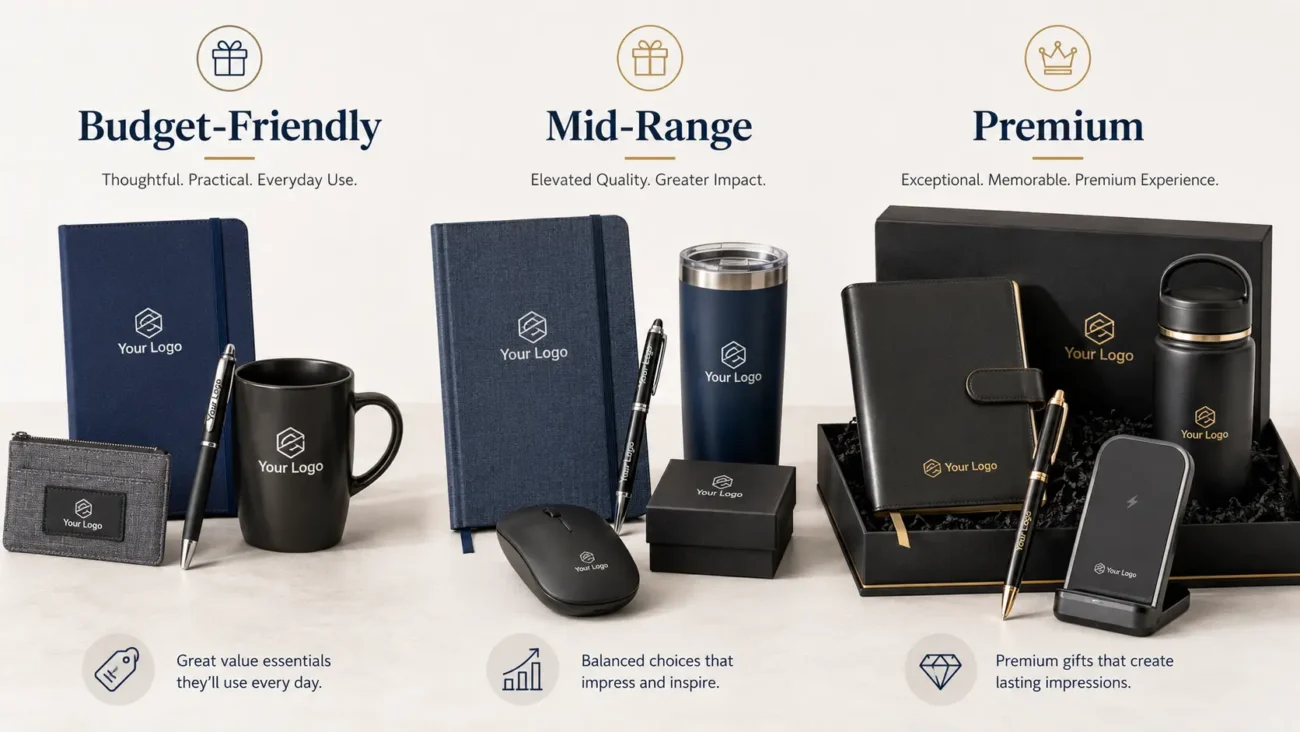
Budget-friendly: notebooks, mugs, bottles, desk accessories, and tote bags. These work well for onboarding kits, event giveaways, or gifting an entire department at once. The trick at this tier is presentation – a plain plastic bag undercuts even a decent item, while a simple branded sleeve or box makes the same product feel deliberate.
Mid-range: insulated drinkware, wireless chargers, desk organizers, and tech gifts that people actually reach for during the workday. This tier is where most year-end and milestone gifting lands, because it allows for real personalization – an engraved name, a subtle logo – without pushing into luxury territory.
Premium: curated gift boxes, branded apparel, wellness bundles, travel essentials, and executive desk sets. Reserve this tier for leadership gifting, major milestones, or client-adjacent moments. At every tier, packaging does more work than people expect – a modest item in a well-designed box consistently reads as more generous than an expensive item handed over loose.
Pick Useful Gifts People Actually Keep
Here’s where most teams get it wrong: they buy for the moment of unboxing instead of the six months after. A gift that photographs well but sits in a drawer isn’t doing its job, no matter how nice it looked on the table.
Categories that consistently earn a place in someone’s routine include insulated drinkware (genuinely used daily), desk and office essentials, practical tech accessories, wellness items like sleep or hydration kits, travel-ready gear, soft apparel, and curated hampers for occasions that call for something more indulgent. The through-line is simple: usefulness is what keeps a gift out of the drawer, and the drawer is where brand recall goes to die.
There’s real data behind this. Recent industry research found that consumers keep branded promotional items specifically because they find them useful, and that people view a brand more favorably after receiving a well-made item. The lesson translates directly to employee gifting: usefulness isn’t a nice-to-have, it’s the mechanism that makes the gift keep working long after the occasion has passed. For hybrid and remote setups specifically, desk items, drinkware, and travel gear tend to outperform anything tied to a physical office.
Branding Without Making It Look Cheap
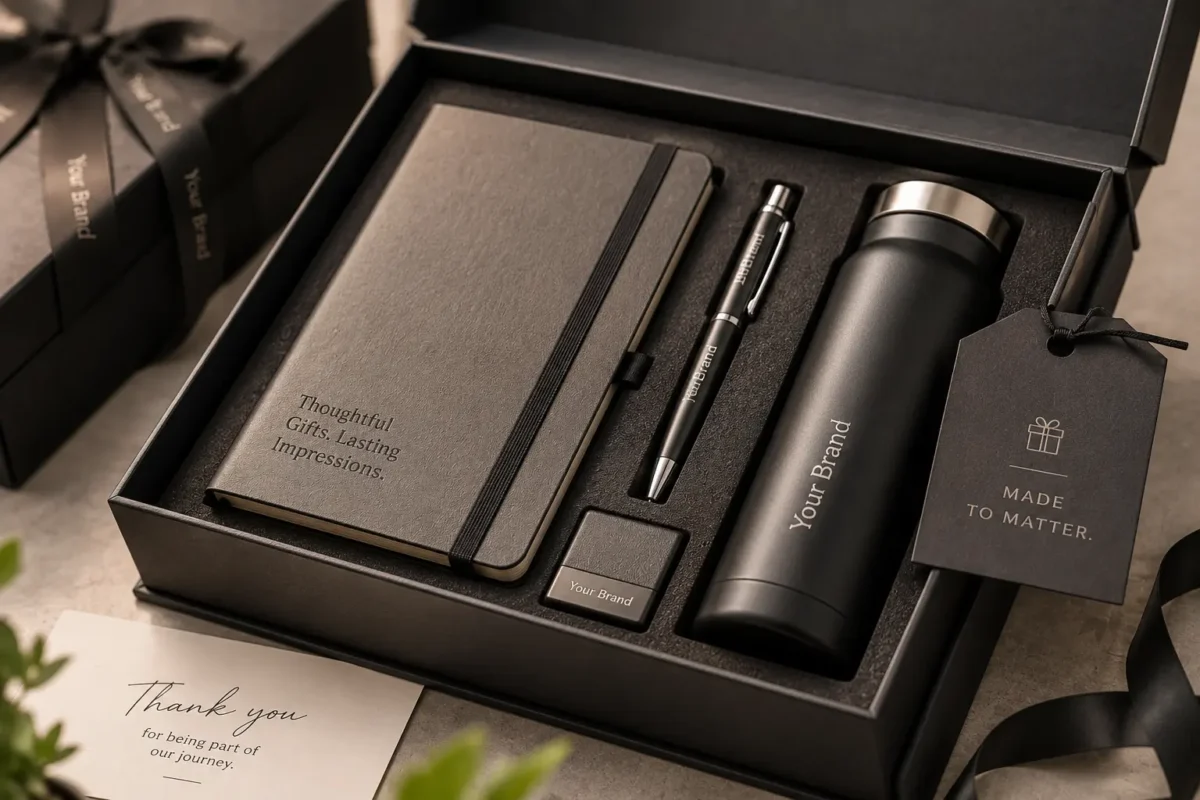
An oversized logo across the front of a mug is the single fastest way to make a gift feel like advertising instead of appreciation. Subtle branding almost always outperforms loud branding – a corner mark instead of a center-chest print, tone-on-tone printing instead of a clashing color block, embossing or engraving instead of a flat decal.
Placement matters as much as size. A small icon on a sleeve tag, an inner-label detail, or a discreet engraving on the base of a bottle all read as deliberate rather than promotional. Premium materials do a lot of the heavy lifting here too – the same logo looks entirely different stitched into leather versus printed on thin canvas.
This is where production quality quietly decides whether a gift feels like a program or a giveaway. Businesses sourcing in bulk usually vet whichever printing company Saudi Arabia clients or peers have used before, since finish quality is nearly impossible to judge from a product photo alone. Custom packaging options are worth the extra step too – the box or sleeve is often the first thing a recipient touches, and it sets the tone before the gift itself is even seen.
Think About the Recipient
Personalization doesn’t need to mean a different gift for every employee – that’s rarely realistic past a small team. It means grouping people sensibly and picking categories that fit those groups, rather than defaulting to one generic item for the whole company.
Job role and work setting are the most useful starting points. A technical team may lean toward gadgets and desk accessories. A sales team that travels often will get more use out of travel-ready gear. A wellness-minded company culture tends to favor self-care kits over branded apparel. Office-based staff often value elegant, everyday-use items, while remote employees get more value from things that upgrade a home workspace.
Age range, lifestyle, and gender-neutral defaults matter too – when in doubt, choose function over novelty, since a genuinely useful item rarely misses. Workplace gifting research also points to a common pitfall worth naming: gifting handled without any thought for cultural or departmental differences can create more awkwardness than goodwill, even with good intentions behind it. Branded apparel is a good example of a category that works broadly, but only when sizing, fit, and style options are genuinely inclusive rather than a single unisex cut.
Best Corporate Gift Ideas for Employees
A few reliable categories, grouped by what they’re best suited for:
Practical gifts – insulated bottles, quality notebooks, desk organizers, charging accessories. These work for almost any occasion and rarely miss, because they solve a small daily annoyance rather than sitting purely decorative.
Wellness gifts – sleep kits, hydration sets, ergonomic desk accessories, self-care bundles. These land especially well for teams under visible pressure or after a demanding quarter, when the gesture of care matters as much as the item.
Premium gifts – curated boxes, awards and plaques for milestone recognition, executive desk sets, and higher-end apparel. Reserve these for genuine achievements so they retain their weight – handing out premium items too casually dilutes what they’re meant to signal.
Seasonal gifts – items tied to a specific holiday or national occasion feel timely without needing to be reinvented every year, as long as they’re not recycled without any refresh in design.
Remote work gifts – desk upgrades, travel-ready gear, and drinkware that ship well and arrive intact tend to outperform anything fragile or bulky.
Branded lifestyle items – apparel, bags, and accessories people would plausibly buy for themselves anyway. These do the most for brand visibility precisely because nobody feels like they’re wearing an advertisement.
What to Avoid When Choosing Employee Gifts
Cheap, flimsy products do more damage than no gift at all – a mug that chips in a week or a pen that stops writing by month two tells the recipient exactly how much thought went into the decision. Overly promotional items, where the logo dominates the object, read as advertising rather than appreciation, and employees can tell the difference instantly.
Generic gifts with no connection to the team or the occasion feel like they were bought in a hurry, because they usually were. Items that are awkward to use or store – bulky, fragile, or oddly shaped – tend to get abandoned regardless of how nice they looked in a catalog. Overly personalized gifts can backfire too; assuming everyone shares the same taste, hobby, or size is a fast way to miss the mark for a meaningful share of the team.
Poor packaging undercuts good products more often than people expect. A well-made item handed over in a plain plastic bag reads as an afterthought, even when the gift itself was chosen carefully.
FAQs
What are the best corporate gifts for employees?
Practical, well-made items people already use daily – drinkware, desk accessories, quality notebooks, and travel gear – consistently outperform novelty items. The best choice depends on the occasion and the team’s work setting.
How much should a company spend on employee gifts?
There’s no fixed number, but budget-friendly, mid-range, and premium tiers each have a place depending on the occasion. What matters more than the amount is that the item feels intentional at whatever price point it sits.
Are branded gifts good for employees?
Yes, as long as the branding is subtle. A discreet logo on a genuinely useful item feels like a gift; a loud logo on a low-quality item feels like advertising.
What gifts work best for remote employees?
Desk upgrades, drinkware, and travel-ready items tend to perform best, since they don’t depend on a physical office. Packaging and shipping condition matter more here than with in-office gifting.
How do I make corporate gifts feel more personal?
Group employees by role, work setting, or department rather than trying to individualize every gift. A well-chosen category feels personal even without a one-off custom item for each person.
Should corporate gifts be the same for everyone?
Not necessarily. A shared baseline gift works for company-wide occasions, but role-based or team-based variation tends to land better for milestones and recognition moments.
What makes a corporate gift feel premium?
Material quality, restrained branding, and packaging – in that order. A modest item in a well-designed box regularly outperforms an expensive item handed over loose.


