
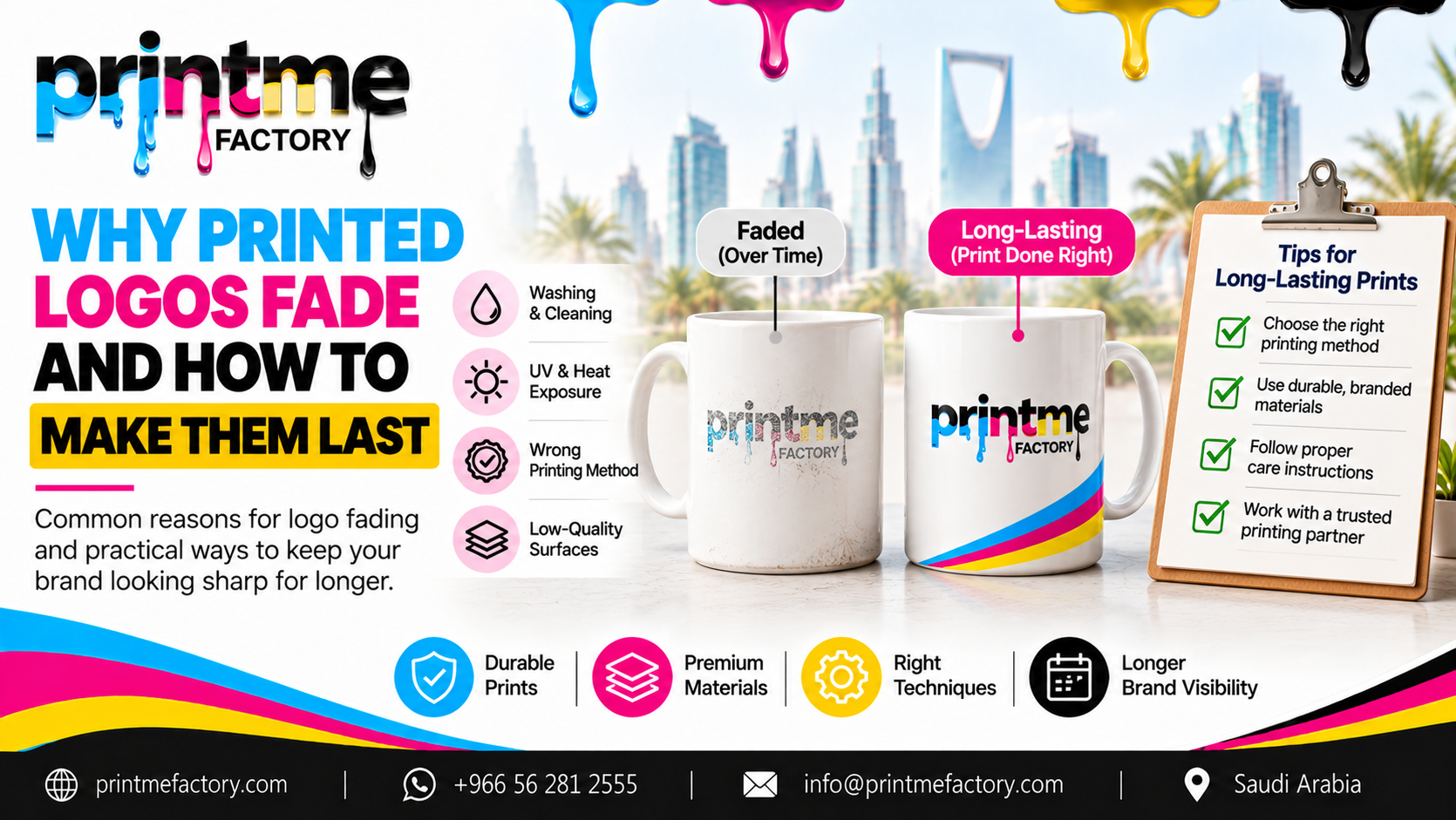
Quick answer: Printed logos fade, crack or peel when the ink doesn’t suit the surface, the surface isn’t prepared so the ink can bond, or the ink is never fully cured. Saudi conditions speed it up: heat inside parked cars, coastal humidity, dust and commercial dishwashers all attack weak prints. To make a logo last, match the method to the material: laser engraving for metal, surface prep plus properly cured UV ink for rigid plastics and glass, and fully cured plastisol or embroidery for fabric.
A while back I rejected an entire incoming batch of glossy promotional flasks before a single one was printed. The powder coating carried a silicone residue from the coating line. On the test piece, the UV-printed logo looked perfect for ten minutes, then lifted off cleanly under my fingernail. Had we printed the run, a client would have handed out a thousand flasks that shed their logo within weeks.
Here is the chemical reality. Nearly every faded or peeling logo I get asked about comes down to one of three things: the wrong ink for the surface, a surface nobody prepared, or ink that never fully cured. None of it is bad luck, and almost all of it is visible on a sample if you know how to test one.
It matters because the logo is the whole point of the item. B2B buyers and ministries ordering corporate gifts in Saudi Arabia expect الطباعة الدائمة, permanent branding that outlives the event it was made for. A logo that flakes off in month two tells the recipient something about your standards, whether you meant it to or not.
Why logos fail, and the permanent fix for each surface
| Material / Surface | Why Cheap Prints Fail | Permanent Factory Fix | Expected Lifespan |
|---|---|---|---|
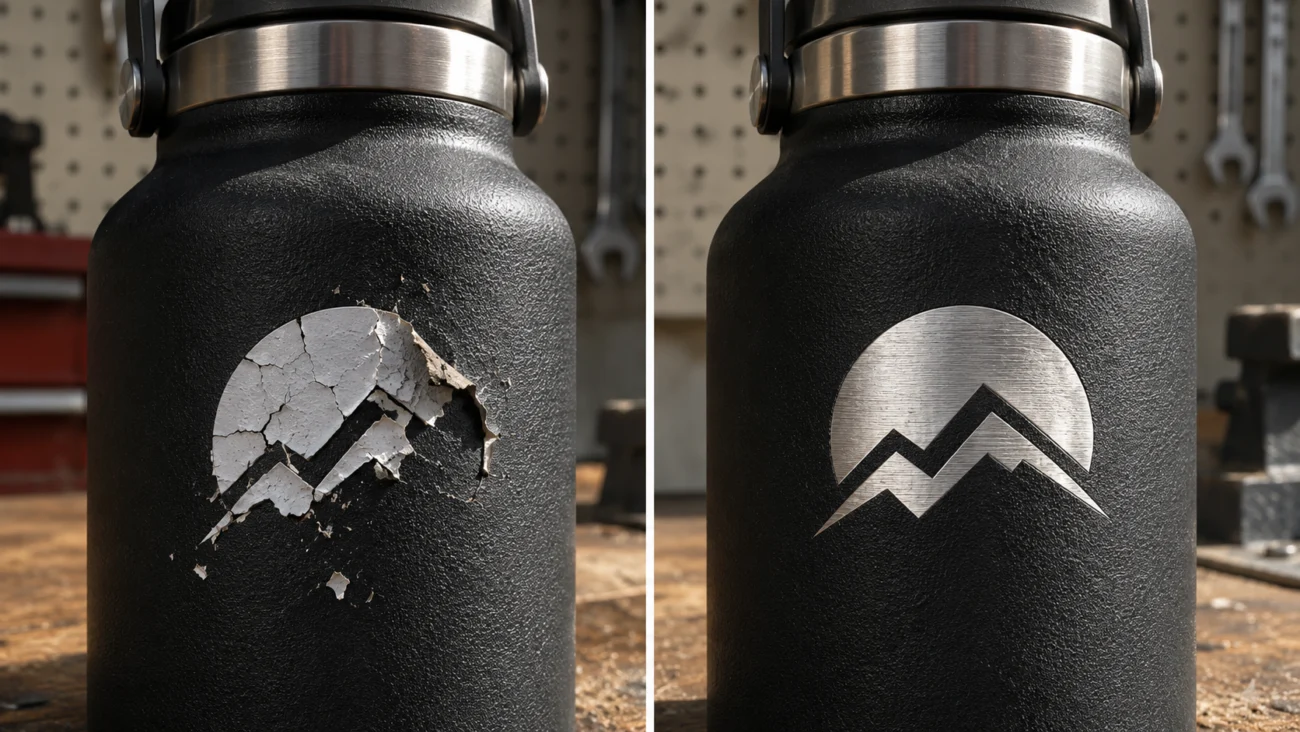
| Stainless steel drinkware and metal pens | Pad print sits on a slick coating; keys, bags and dishwashers scratch it off | Rotary fiber laser engraving through the coating | As long as the product |
| Hard plastics and acrylic | Ink beads up on low-surface-energy plastic and peels | Corona or flame treatment, primer, then fully cured UV ink or UV DTF | Years of normal use; shorter with daily scrubbing or constant sun |
| Ceramic mugs | Surface prints strip in hot, alkaline commercial dishwashers | Sublimation on coated mugs, or fired ceramic decals for heavy use | Fired decals: life of the mug |
| Cotton apparel and caps | Under-cured ink cracks after a few washes | Plastisol cured through at about 160°C, or embroidery | Life of the garment |
| PU leather notebooks | Surface ink peels along flex creases | Blind heat debossing | Permanent |
The Root Causes: Why Printed Logos Fade, Peel, and Crack
Low Surface Energy (LSE) Plastics and Unprepped Metals
Ink has to wet a surface before it can bond to it. Whether it does depends on surface energy, measured in dynes per centimetre. If the surface energy is lower than the ink’s surface tension, the ink beads up at a microscopic level, the way water sits on a waxed car, instead of spreading out and gripping.
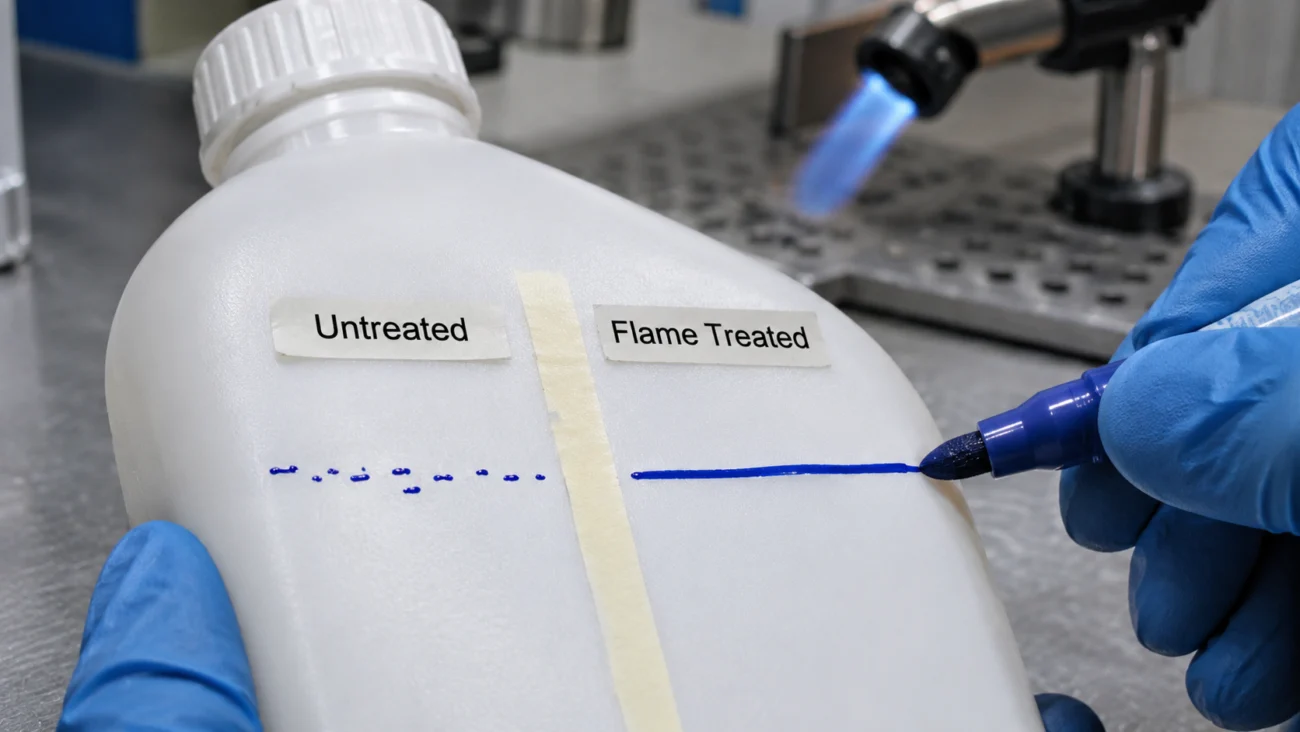
Polypropylene (PP) and polyethylene, including HDPE, sit around 29 to 31 dynes/cm. Silicone is lower still. Most printing inks want the surface in the high 30s or above, and a common shop rule is to have the surface roughly 10 dynes higher than the ink. Print straight onto untreated PP and the logo looks fine on day one, then peels off cleanly within weeks.
The fix is surface treatment. The polypropylene bottles are passed through a flame-treatment station to raise surface dyne levels before ink ever touches the plastic. Flat items and films get corona treatment or a chemical primer instead. We check the result with dyne test pens: draw a line, and if it beads within a couple of seconds, the surface is not ready. Treatment also fades over time, so treated parts should be printed soon, not left on a shelf for a month.
You will watch your company logo flake off like dried mud if you print directly onto untreated silicone or glossy metal. Silicone needs silicone-based inks; ordinary inks have nothing to hold on to. Metal and powder coat need degreasing, because the oils, release agents and silicone additives left from manufacturing form an invisible barrier, which is exactly what killed those flasks.
Under-Cured Inks and Wrong UV Wavelength Calibration
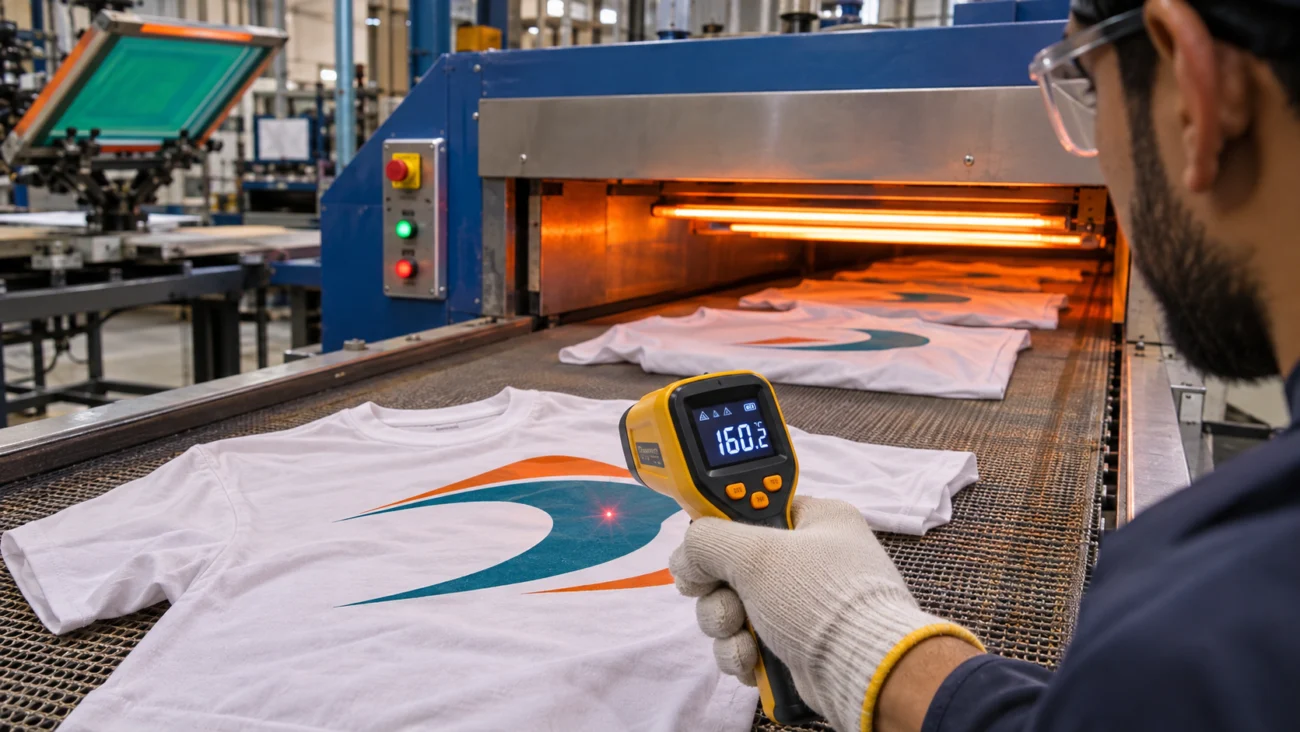
Rushed jobs fail in the curing, not the printing. Plastisol ink on a t-shirt does not dry in air; it has to reach roughly 160°C (320°F) all the way through the ink layer so the resin fuses with the fibres. If the conveyor belt moves too fast or the dryer runs cool, only the top skin cures. The print looks finished and passes a quick glance. The first wash cracks it into spiderwebs.
Humidity plays a part too. Look at what happens on the factory floor in Jeddah during a humid spell: the cotton blanks soak up moisture from the air, and that water drinks heat as it evaporates in the dryer. We once had to dial up the conveyor dryer temperature mid-run because the ink film was falling short of full fusion. Without a temperature check at the ink surface, nobody would have caught it until the client’s first wash.
UV inks fail for a different reason. They cure when photoinitiators in the ink absorb light at the right wavelength and the resin cross-links into a hard film. LED curing lamps emit at specific wavelengths, commonly 365, 385, 395 or 405 nanometres, and the ink chemistry has to match the lamp. A mismatch, or an ageing lamp that has lost intensity, leaves the print slightly tacky, smelly and weakly bonded. UV curing is fast and durable when it is calibrated, and fragile when it isn’t.
Saudi Environmental Stressors: Extreme Heat, UV Rays, and Dishwashers
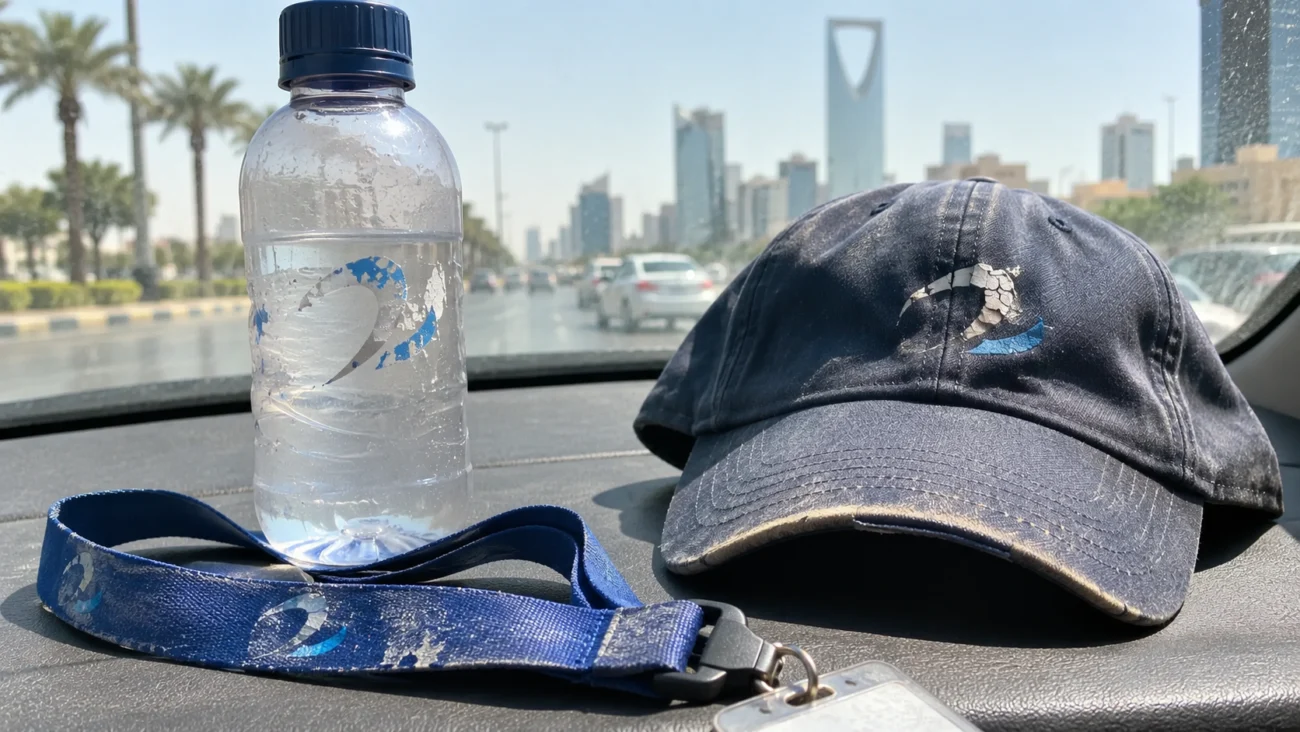
Saudi conditions find every weak print. Even on 10 September 2026, the National Center for Meteorology forecast 47°C in Dammam and a 30°C overnight low in Jeddah. A promotional item left on a car dashboard in Riyadh sits far hotter than the air outside, which softens cheap adhesives, bakes standard inks and turns a marginal bond into a failed one.
Sunlight does slower damage. UV radiation breaks down pigments, so cheap colors fade, reds and oranges usually first, on anything that lives outdoors. Jeddah’s coastal humidity and salt air work into any print that was poorly bonded at the edges, and dust on industrial sites acts like fine sandpaper on anything raised above the surface.
Then there are dishwashers. Everyday items in the customized corporate gifts category, such as ceramic mugs and insulated tumblers, take the worst physical abuse. Commercial machines use very hot final rinses and strong alkaline detergents, which strip surface prints in weeks. Hospitality is growing fast, too: the Ministry of Commerce counted 20,560 active registrations for tourist accommodation at the end of Q3 2026, up 29% year on year. Every hotel and café buying branded mugs needs prints built for that machine, not for a home sink.
Event merchandise has its own stress test. Saudi event ticket volumes rose 34% year on year in July and August 2026, according to Platinumlist data, which means more caps and t-shirts worn in summer sun, washed, and worn again. Those الهدايا الدعائية only work as advertising if the print survives the second wash.
How to Make Printed Logos Last on the Jeddah Factory Floor
Durability is decided before the logo is applied: by choosing the right process for the material, preparing the surface, and proving the cure.
Replacing Ink with Fiber Laser Engraving on Metals
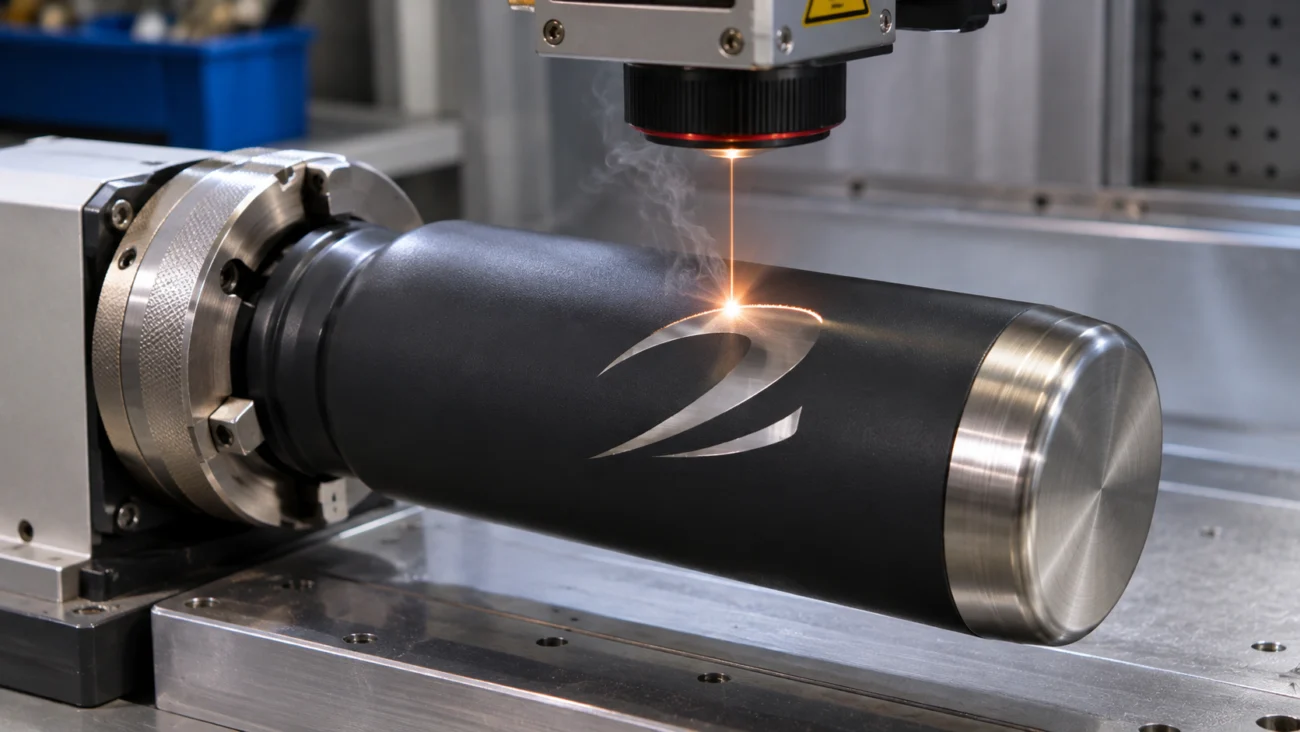
For metal, the most permanent print is no print at all. With النقش بالليزر, laser engraving, there is no ink to fade, because the fiber laser removes the top anodized or powder-coated layer and exposes the bare metal underneath. On uncoated stainless steel, it marks the surface itself.
Flasks and stainless steel bottles are loaded onto a rotary attachment so the laser can wrap the logo cleanly around the curve. The same applies to metal pens, which is one reason metal pens make effective corporate gifts: the engraved mark lasts as long as the pen. Aluminium power bank casings take a laser mark just as well.
Let’s be blunt about keychains. A Riyadh procurement manager once asked me for full-color prints on metal key holders. I talked him out of it. A keychain lives in a pocket with coins and keys, and a color print on metal wears through in weeks. We switched the order to deep fiber laser engraving, and the logo will still be there when the keyring breaks.
The trade-off is color. Engraving is single-tone. For flat awards the same choice comes up, which is why we compared laser-engraved vs. printed aluminum plaques in detail. If your brand guidelines allow a single-tone mark, engraving is the safest decision you can make.
Adhesion Promoters and UV DTF Curing for Rigid Goods
Some items need full color: acrylic awards, glass, rigid plastic cases. For these, permanence comes from preparation. The surface is wiped with isopropyl alcohol to remove oils and fingerprints, treated or primed with an adhesion promoter matched to the material, then printed with UV ink cured under high-intensity LED lamps so the polymer cross-links onto the surface instead of resting on it.
UV DTF follows the same logic. The logo is printed onto a film with its adhesive layer and protective varnish, cured, then pressed onto the item. On a properly cleaned and primed rigid surface it holds well for years of normal handling. It is not the right choice for something scrubbed daily or left in the sun all summer, and I would rather tell a client that before printing than after.
Mugs are their own category. Ceramic mugs can be sublimated, screen printed or UV printed, and for heavy commercial washing, fired ceramic decals, where the design is fused into the glaze in a kiln, outlast the rest.
Full-Fusion Plastisol Curing and Embroidery for Textiles
For uniforms and event wear, the answer is either a print that is fully fused or thread that is sewn in. Plastisol on t-shirts and polo shirts lasts the life of the garment when the whole ink layer reaches cure temperature, which we confirm with a temperature reading at the ink surface rather than trusting the dryer dial. Every new run gets a stretch test, pulling the printed area firmly, and a sample goes through a wash cycle before we release the rest.
DTF transfers are a good option for detailed, multi-color designs on dark garments, provided they are pressed at the correct temperature, pressure and time and pass the same stretch and wash tests. For caps and polo shirts, high-stitch-density embroidery is hard to beat: the logo is literally sewn into the fabric, so there is nothing to crack or peel.
Quality Control Checklist Before Approving a Bulk Print Run
When a client picks up one of your promotional gifts and sees a cracked, half-peeled logo, it signals poor quality control across your whole business. Run these checks on a physical sample before you approve the order.
- Request a physical pre-production sample, not just a PDF mockup, before approving 1,000+ units.
- Do the fingernail scratch test: press firmly across the print edge. Nothing should lift.
- Do a cross-hatch tape test (the method in ASTM D3359 or ISO 2409): cut a small grid through the print, press on strong tape, rip it off, and check how many squares lifted.
- For apparel, stretch the printed area and wash one sample before approving the run.
- Choose laser engraving or debossing over ink whenever your brand guidelines allow a single-tone finish.
- Confirm dishwasher suitability for drinkware, and sun resistance for outdoor items.
- Ask how the supplier verifies cure: dryer temperature readings for plastisol, lamp checks for UV.
Work directly with an in-house Saudi manufacturer, so quality control happens on the factory floor, not through three layers of brokers.
FAQs
Why do printed logos peel off plastic water bottles and pens?
Usually because the plastic has low surface energy and was not treated before printing. Flame, corona or primer treatment fixes it.
What is the most permanent way to put a company logo on metal corporate gifts?
Fiber laser engraving. It removes the coating or marks the metal itself, so there is no ink to wear off.
How do you stop a printed logo from cracking on corporate t-shirts and uniforms?
Cure the plastisol fully, at about 160°C through the whole ink layer, and wash-test a sample. For caps and polos, embroidery is the safest option.
Does UV DTF printing fade in the Saudi sun and heat?
It holds well indoors on properly prepared surfaces. With constant outdoor sun or daily scrubbing it wears faster, so choose engraving for those items.
Are printed corporate mugs safe to put in a commercial dishwasher?
Only if they are made for it. Fired ceramic decals survive commercial washing; most surface prints do not.
How can I test if a supplier’s logo print will last before ordering in bulk?
Get a physical sample and run a fingernail scratch test and a cross-hatch tape test on it. For apparel, add a stretch test and one wash.


