
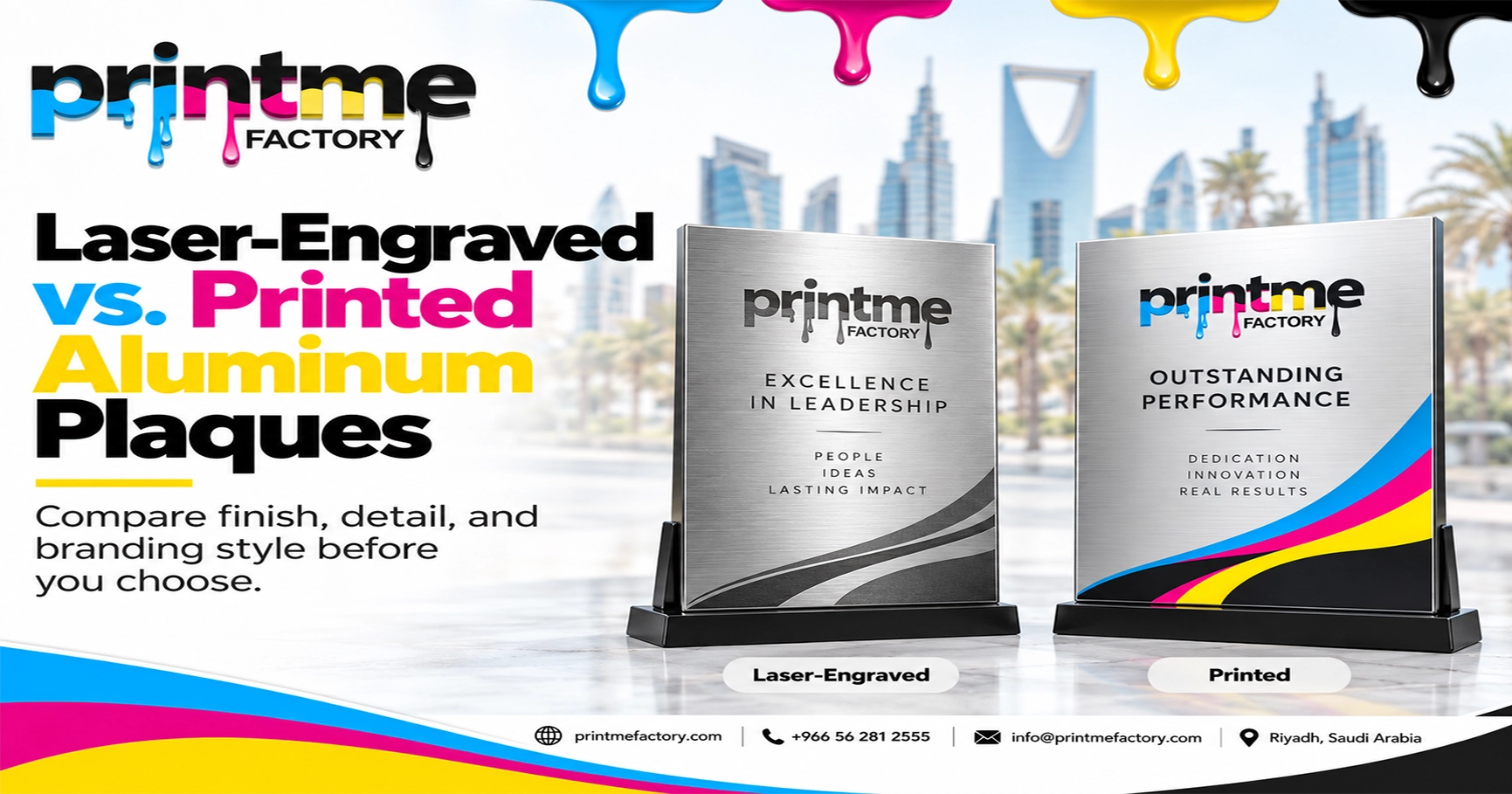
Quick Answer: Laser-engraved aluminum creates a permanent, tactile finish by marking directly into the coated metal, making it well suited to classic executive awards, recognition plaques, and designs where understated presentation matters. Printed aluminum, using methods such as sublimation or UV DTF, is better when the design requires full-color logos, detailed graphics, gradients, or close adherence to brand colors. The right choice ultimately depends on your priority: choose printing for color-rich brand reproduction and laser engraving for a traditional, durable, premium finish.
When clients walk into our Jeddah showroom with a highly complex logo, my first question is never about budget. It’s about color – specifically, whether the design can survive being reduced to a single tone. That one question decides the entire production path before anything touches a machine, and skipping it is how a client ends up disappointed with a perfectly well-made plaque.
Aluminum has genuinely earned its place at the center of that conversation. Saudi Arabia’s aluminum sector is having a real moment right now – ALUMINIUM Arabia, a new dedicated trade event backed by the Ministry of Industry and Mineral Resources, launches in Riyadh from April 27-29, 2026, reflecting how central the metal has become to the Kingdom’s manufacturing base. That local depth is exactly why our factory runs both fiber lasers and sublimation presses on the same floor – we’re not limited to whichever machine happens to be available.
Browsing our catalog of Aluminum Plaques, the first decision every buyer has to make is engrave or print. Here’s the technical reality behind both, so that decision gets made on purpose instead of by accident.
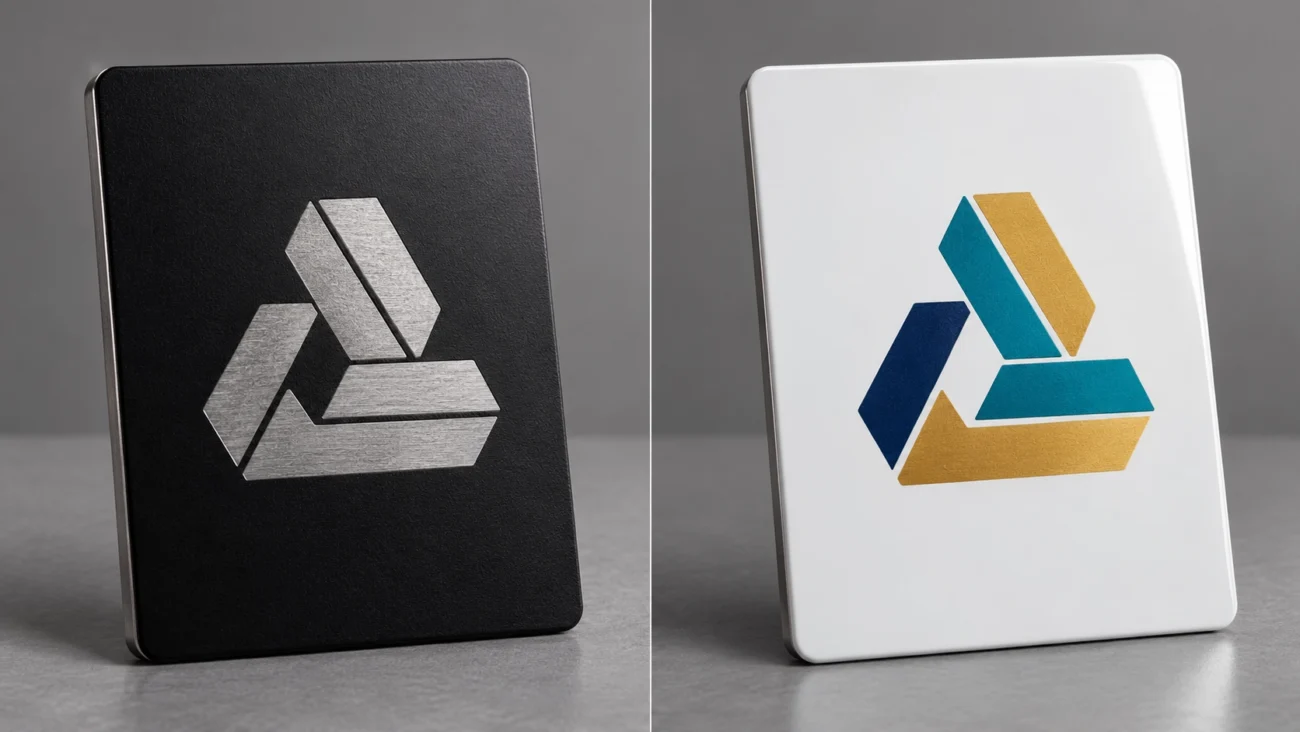
Laser-Engraved vs. Printed Aluminum – Quick Comparison
| Factor | Laser-Engraved | Printed (Sublimation / UV) |
|---|---|---|
| Color Range | Typically two-tone – the coated surface plus the exposed metal beneath | Full-color reproduction with close brand and Pantone color matching |
| Texture | Tactile with a slightly recessed engraved finish | Smooth, printed surface |
| Best for Logos With | Simple shapes, single-color artwork, and clean wordmarks | Gradients, shadows, multiple colors, and photographic detail |
| Durability | Highly durable because the design is permanently marked into the surface | Scratch-resistant, although prolonged outdoor exposure can affect printed color over time |
| Typical Feel | Traditional, understated, and executive | Modern, brand-focused, and corporate |
| Best Use Case | Industrial safety awards, executive recognition, and minimalist designs | Government awards, branded corporate plaques, and detailed certificates |
Why Aluminum is the Undisputed King of Corporate Awards in KSA
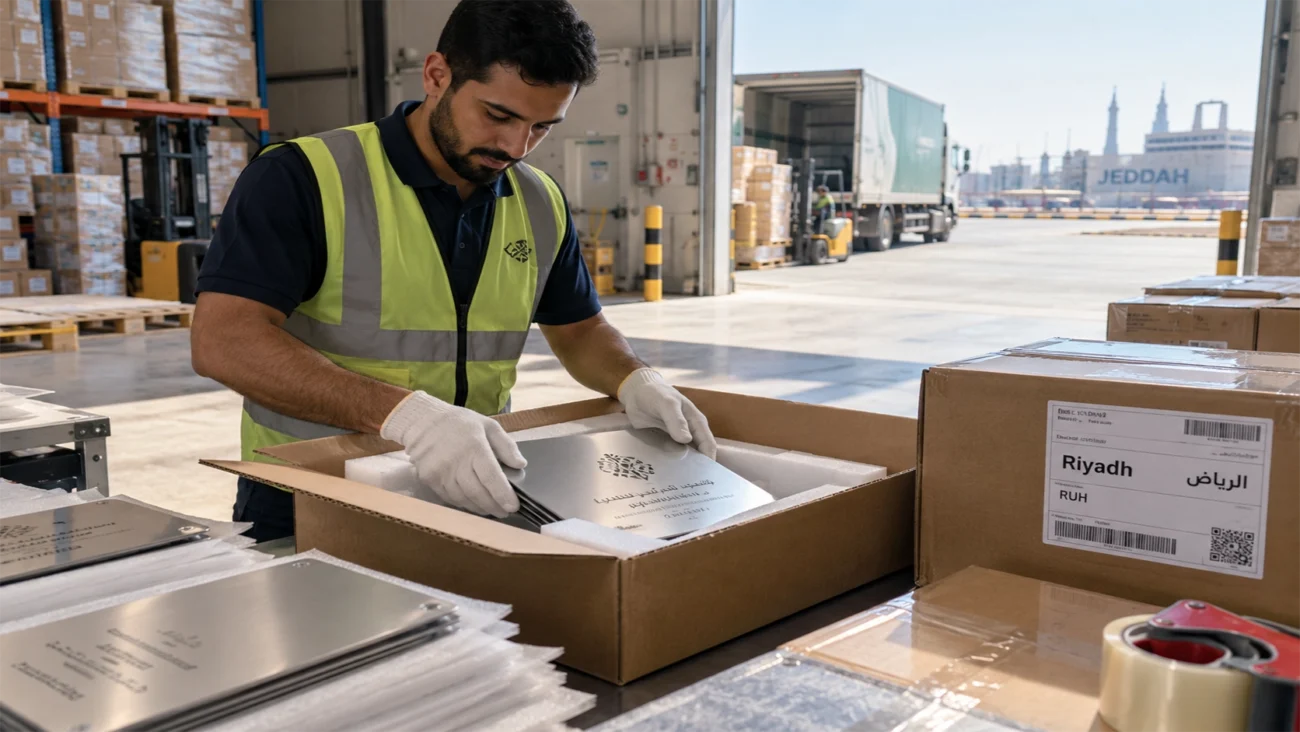
Aluminum has quietly overtaken fragile glass and heavy crystal awards for a large share of Saudi corporate recognition programs, and the reasons are almost entirely practical rather than aesthetic. It’s light enough that shipping a batch from Jeddah to a branch office in Riyadh or Dammam is a non-event, where the same volume in crystal would need padded crating and a genuine prayer.
It also shrugs off the Kingdom’s climate in a way glass never will – high resistance to tarnishing, no risk of humidity fogging or clouding a finish, and none of the corner-chipping that turns a beautiful crystal piece into a liability the moment it’s dropped. For anything that has to survive a delivery truck, a site visit, or an outdoor ceremony, aluminum simply removes an entire category of risk from the conversation.
Laser-Engraved Aluminum: The Permanent Prestige
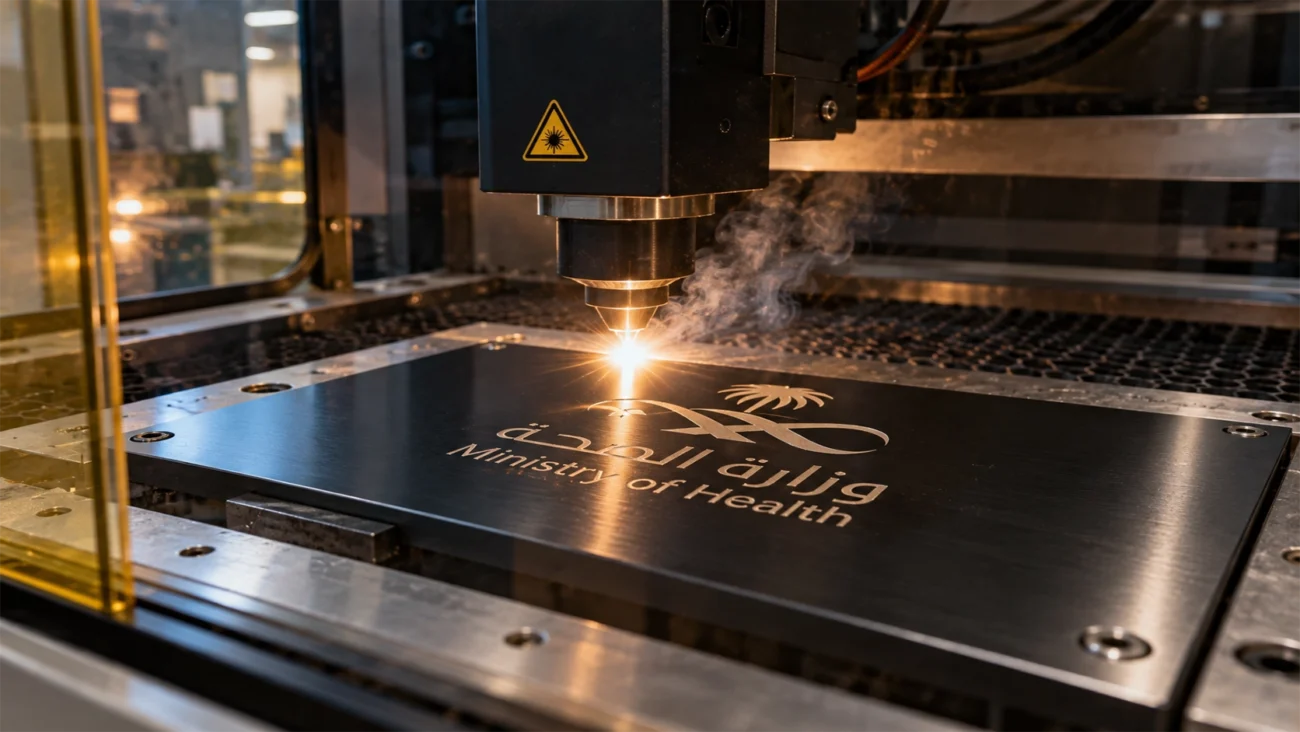
Here’s the technical reality of how this actually happens on our factory floor. A fiber or CO2 laser burns away the top anodized layer of the plaque – usually black, blue, or gold – to reveal the contrasting silver or brass aluminum core sitting underneath. The design isn’t sitting on the surface; it’s cut into it, which is the entire source of its permanence.
The pros are straightforward: it’s highly tactile, it genuinely cannot scratch off since there’s no surface layer to lose, and it carries a traditional luxury that a flat print can’t quite replicate – running a finger across an engraved logo tells the recipient something about the award’s weight before they’ve even read the name on it. But there is a catch, and it’s a strict one – laser engraving is fundamentally a two-tone process. Background color plus revealed metal color, full stop. No gradients, no drop shadows, no full-color logo, no matter how much a client wants one.
This makes engraving the right call for industrial safety awards, classic certifications, and minimalist luxury designs – anywhere a clean wordmark or a simple icon carries more weight than color ever would. It’s the wrong call the moment a brand’s identity depends on an exact shade being visible.
Printed Aluminum (Sublimation & UV): The Full-Color Champion
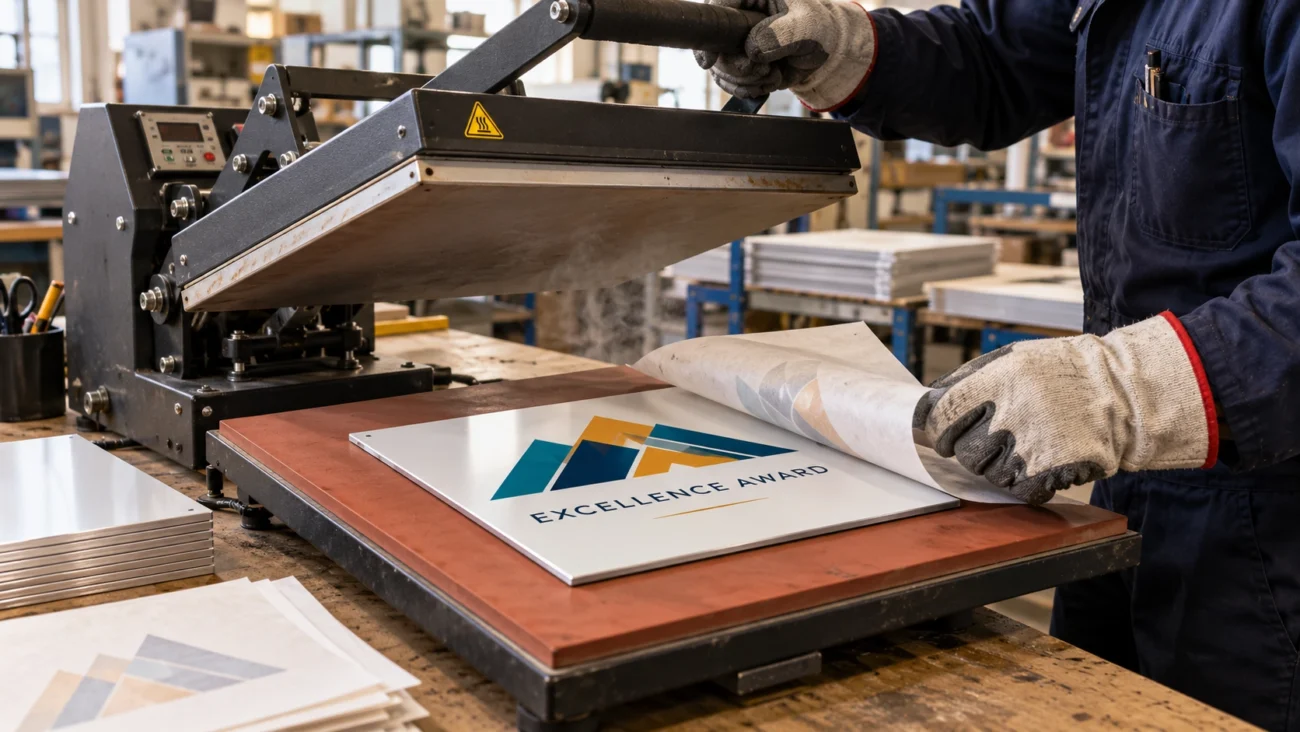
Sublimation works on a completely different principle. Heat – around 400°F – and pressure turn solid ink into a gas, which then embeds itself permanently into a polymer-coated aluminum sheet. The ink isn’t sitting on top of the metal when it’s done; it’s become part of the coating itself, which is why a well-made sublimated piece feels smooth rather than printed when you run a hand across it.
The upside is flawless reproduction of complex logos, gradients, and exact Pantone matching – genuinely photographic quality when the source file is good. But there is a catch here too: the finish is smooth to the touch, with none of engraving’s tactile depth, and prolonged direct sunlight can cause fading over many years if the plaque is used outdoors without added UV protection.
This is the method for government awards with strict color guidelines, modern corporate milestones, and any certificate where the detail genuinely matters – the kind of job where a client says “it has to be exactly this green” and means it. Government and ministry gifting in particular carries its own decorum, and Corporate Gifting Etiquette in Saudi Arabia is worth reviewing before finalizing a design intended for that audience.
Head-to-Head Comparison: Color vs. Texture vs. Durability
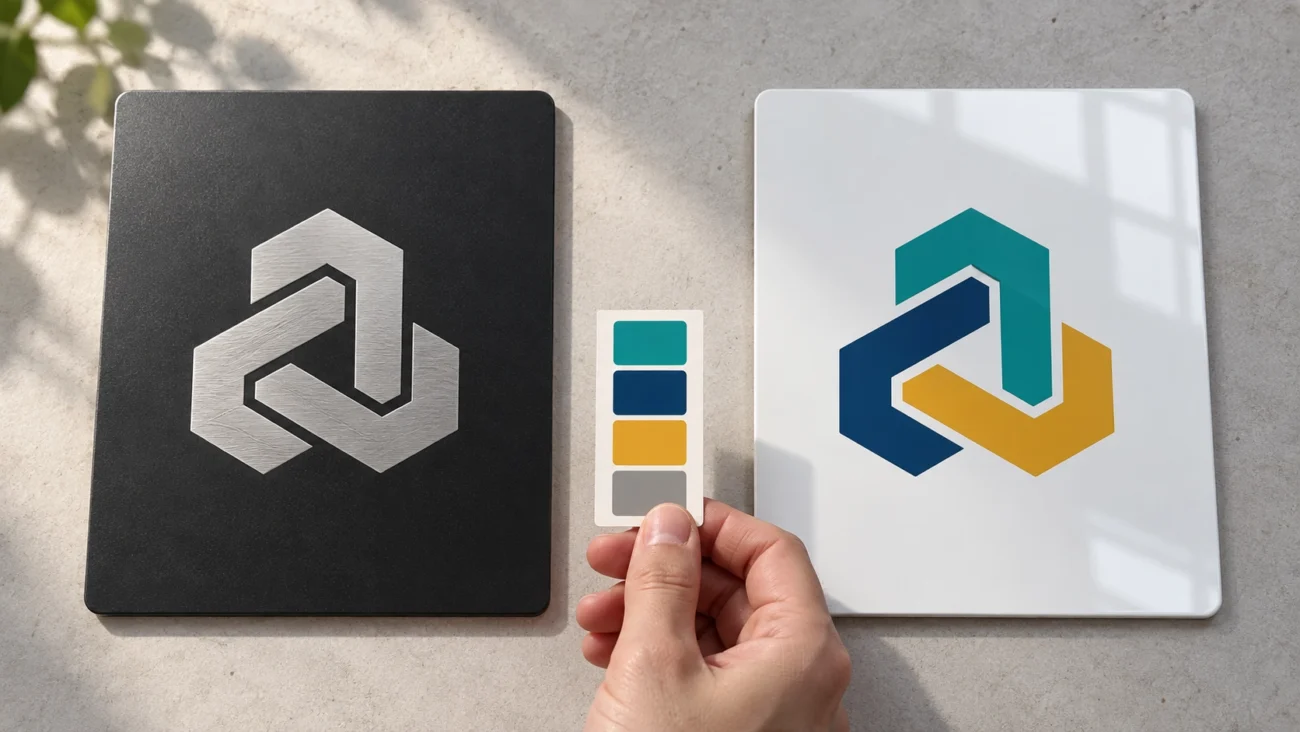
Visual impact splits cleanly along the same line as everything else here: engraving wins on texture and gravitas, printing wins on color accuracy and detail. Durability in harsh environments favors engraving slightly, since there’s no coating layer to worry about degrading – though a properly sublimated plaque kept indoors or under any kind of cover holds its color for years without issue. The real-world difference only shows up outdoors, over a long enough timeline that most buyers never actually see it firsthand.
Production speed for bulk orders usually favors whichever machine isn’t already booked that week, which is a more honest answer than most factories will give you. But there’s a third option worth knowing about: some companies use a hybrid approach, applying UV DTF printing on top of a brushed aluminum base to get both the metallic texture and full color in the same piece. It’s a genuine middle ground when neither pure method quite satisfies the brief, and we’ve started seeing more requests for it as brand teams get more comfortable asking for exactly what they want rather than accepting whichever option a supplier offers first.
Worth remembering too: a plaque going to one recognized individual sits on a completely different budget logic than a mass-distributed Promotional Gifts run for three hundred event attendees. The permanence conversation only matters because the recipient list is short and the relationship is real – for high-volume giveaways, neither engraving nor sublimation aluminum is the right tool for the job in the first place.
How We Manufacture Both in Our Jeddah Factory
Because both machines sit on the same floor here, we don’t push a client toward one method just because it’s all we happen to have running that day. If the award is going to sit in a harsh industrial environment in the Eastern Province, I always recommend engraving – it simply has fewer failure points outdoors. If it’s a government award where exact Saudi Green color-matching is non-negotiable, sublimation is the only honest answer. Neither recommendation costs us anything either way, which is exactly why it’s worth asking a supplier upfront whether they even own both machines before trusting their advice on which one to use.
That kind of local production alignment matters more broadly too. Saudi Arabia’s push toward Saudi Made manufacturing under Vision 2030 has made in-Kingdom production capability a genuine procurement consideration for many organizations, not just a nice-to-have – fewer import delays, direct quality control, and a shorter feedback loop when a mock-up needs a correction before the full run starts.
This is also where a broader Corporate Gifts in Saudi Arabia strategy pays off – end-of-year award programs, National Day recognition, and one-off executive milestones all draw from the same two production methods, and knowing which one fits which occasion in advance saves a genuinely stressful conversation the week before a ceremony.
Technical Checklist for Preparing Your Plaque Artwork
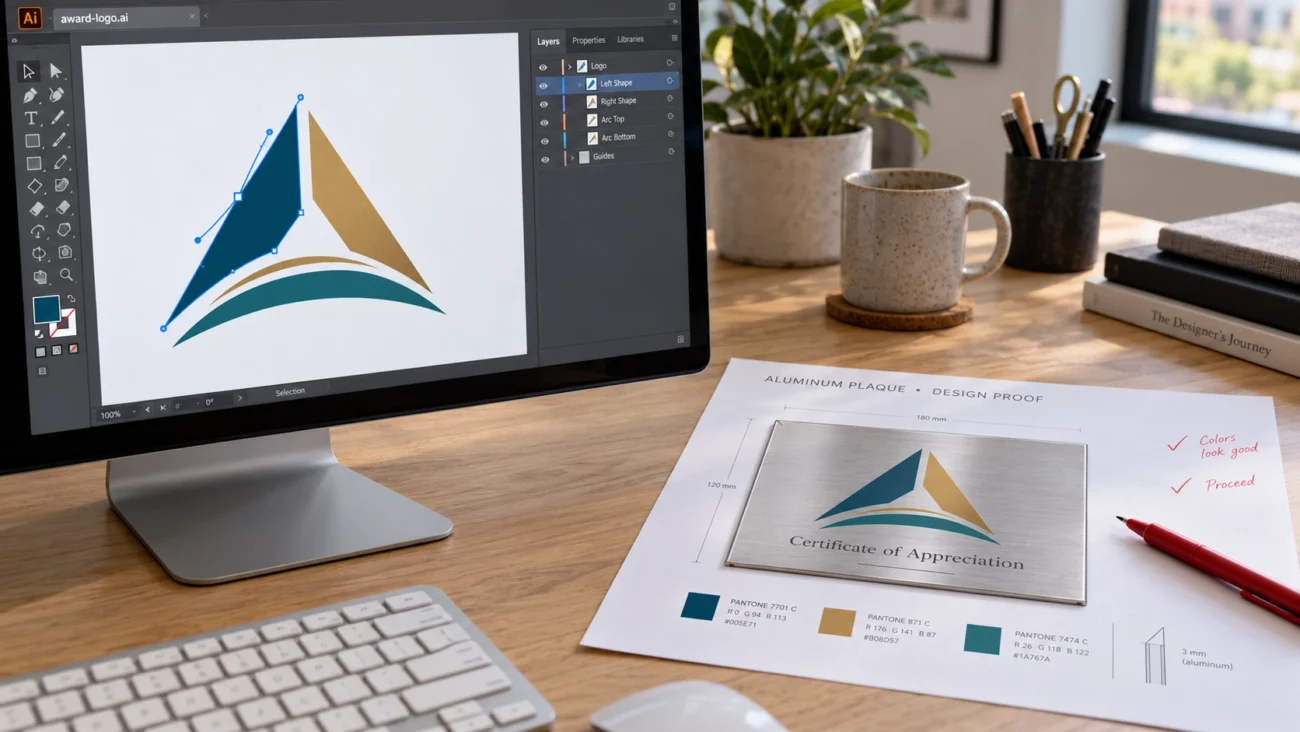
- If engraving: convert all logos to true black-and-white vector files (.AI or .EPS) – no gray shading, since engraving can’t render it.
- If printing: ensure logos are high-resolution or vector with specified CMYK or Pantone values attached.
- Verify all Arabic and English spelling and name titles – this step alone catches most last-minute production delays.
- Choose the backing: a wooden base for warmth, or an acrylic standoff for a cleaner, modern presentation. For recurring recognition programs, How to Choose Corporate Gifts for Employees covers the broader framework worth pairing with this decision.
- Request a digital proof to verify logo placement and margin spacing before the run starts, not after.
FAQs
Can I get a laser-engraved aluminum plaque in full color?
No – engraving is strictly a two-tone process, limited to the plaque’s background color plus whatever metal tone the laser reveals underneath. For full color, sublimation or UV printing is the only route.
Will the print on a sublimated aluminum plaque scratch off?
No, because the ink is embedded into the polymer coating rather than sitting on top of it. It resists scratching well, though extended direct sunlight over many years can fade it if it’s used outdoors without added protection.
Which method is faster for bulk employee awards in Saudi Arabia?
It depends on which machine has open capacity that week, but sublimation generally handles large full-color batches efficiently, while engraving is just as fast for simple, single-color designs.
What is the best method if our corporate logo has gradients and shadows?
Sublimation or UV printing, without question. Engraving physically cannot reproduce a gradient or a drop shadow – it can only reveal one contrasting metal tone against the background.
Do you attach the aluminum plates to wooden bases?
Yes – mounting an engraved or printed aluminum plate onto a wooden base is one of our most common requests, combining the warmth of wood with the precision of metal branding.
Can Print Me Factory match the exact Saudi Green for government awards?
Yes, through sublimation printing with the correct Pantone reference supplied upfront. Exact color matching on engraved pieces isn’t possible, since engraving only reveals the base metal tone rather than applying a custom color.


3 thoughts on “Laser-Engraved vs. Printed Aluminum Plaques”
Comments are closed.