
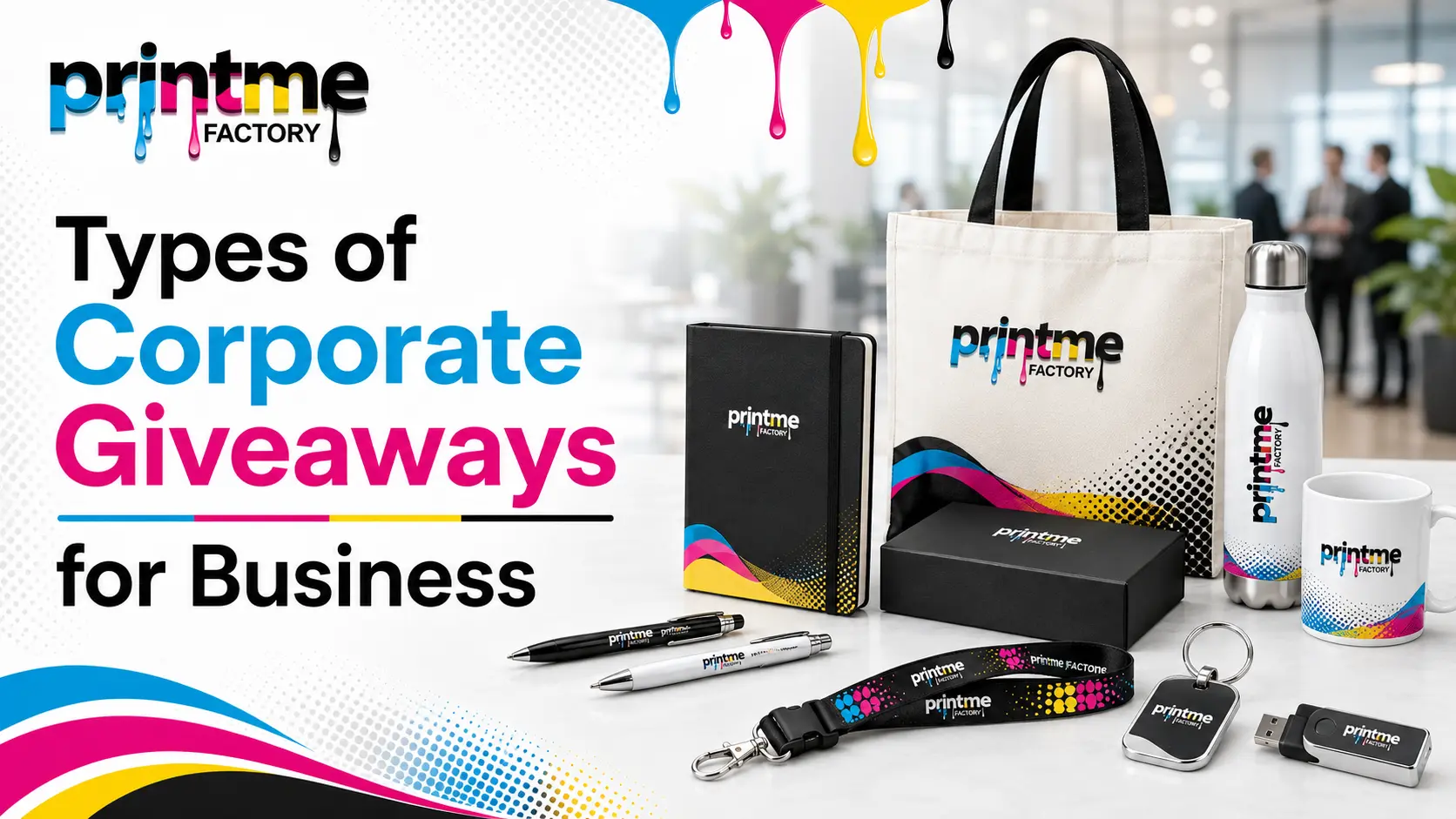
Short Answer: The main types of corporate giveaways include office accessories and stationery, branded drinkware, food and beverage gifts, tech gadgets, apparel, eco-friendly products, premium gift sets, and personalized or experience-based gifts. Each category supports a different objective, whether you are planning an event, rewarding employees, strengthening client relationships, or increasing brand awareness. The best choice is the one that fits the audience and purpose, not necessarily the option with the highest price.
A corporate giveaway isn’t just “free stuff.” It’s a small, physical decision about how a brand wants to be remembered – and the category it comes from shapes that outcome more than the logo does. A tote bag says something different from a crystal award, which says something different from a power bank, even if all three cost roughly the same to produce.
This matters more in Saudi Arabia right now than it did a few years ago, simply because there’s more of it happening. The Kingdom’s event management sector is projected to grow from around $2.6 billion in 2025 to nearly $2.8 billion in 2026, which means more conferences, more exhibitions, and more branded items changing hands across Riyadh, Jeddah, and Dammam. What counts as promotional merchandise has also broadened well past the pen-and-mug era – tech accessories, eco-friendly products, and curated gift sets are now standard categories, not novelties.
The most effective giveaways, across every category, share one trait: people actually use them. A pen that writes well, a bottle that survives a gym bag, a charger that lives on a desk – these do more for a brand over six months than a flashier item that gets used once and forgotten. This guide breaks down the main types of corporate giveaways for business, where each one fits, and how to avoid wasting budget on the kind of swag nobody wanted in the first place. None of this requires guessing – the category almost always announces itself once the audience, occasion, and budget are pinned down.
Overview of the Main Types
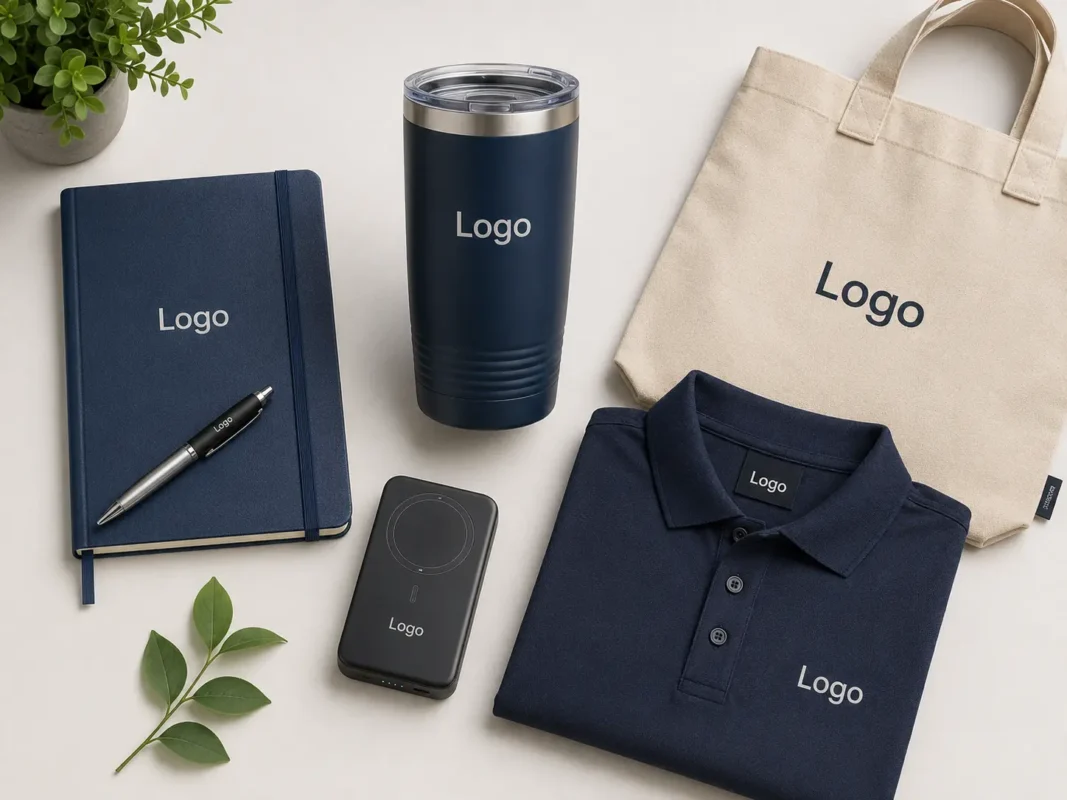
Here’s the landscape before diving into detail on each one:
- Office accessories and stationery – pens, notebooks, organizers; the daily-use category.
- Drinkware and food & beverage gifts – bottles, mugs, hampers; built around routine and hospitality.
- Tech gadgets and accessories – chargers, power banks, cables; modern and genuinely useful.
- Branded apparel – shirts, caps, jackets; doubles as swag and, sometimes, uniform.
- Eco-friendly products – recycled, bamboo, and reusable items with a sustainability story attached.
- Luxury and premium gift sets – for the handful of relationships that justify real spend.
- Personalized and experience-based gifts – engraved, monogrammed, or tailored to one specific person.
Office Accessories & Stationery
This is the reliable, unglamorous workhorse of corporate gifting, and there’s no shame in leaning on it. Pens, notebooks, planners, desk organizers, and mousepads live on a desk – not in a drawer – which means they keep working for the brand long after the event or the onboarding day that handed them out. Onboarding kits in particular lean on this category heavily, since a new hire’s first desk setup is one of the few moments a company can shape entirely on its own terms.
Print Me Factory’s Writing range covers the gap between a throwaway plastic pen and something with real weight in the hand, and the Notebooks category matters more than people expect – paper quality is the difference between a notebook someone fills up and one that gets abandoned after the first page.
Print area and branding placement deserve a second look too. A logo stamped edge-to-edge on a notebook cover reads as promotional; a small, clean mark in the corner reads as considered. For anything meant to sit permanently on a desk – organizers, small trays, sign holders – the Desk Items Sets category is worth a look specifically for onboarding kits and internal recognition gifts, where the audience is smaller and the item can afford more thought.
Drinkware & Food/Beverage Gifts
Reusable bottles, coffee tumblers, mugs, and glassware are long-life branded items almost by default – someone either drinks from them daily or doesn’t keep them at all, and the ones that survive the first week tend to stay in rotation for years. That staying power shows up in the local numbers: Saudi Arabia’s reusable bottle market was valued at $219.4 million in 2024 and is projected to reach $307.7 million by 2030, a category growing specifically because durable drinkware is displacing single-use plastic in both retail and corporate gifting. The Drinkwares category performs particularly well at conferences, staff wellness programs, and client gifting, where the item needs to feel useful on day one and still look good a year later.
Food and beverage gifts work on a different logic entirely. Snack boxes, gourmet hampers, and coffee or tea sets aren’t about daily branding – they’re about a single, warm moment tied to a holiday, a closed deal, or a season. Usefulness and shareability are what make both halves of this category work: a drinkware item earns its keep through repetition; a hamper earns its keep by being genuinely enjoyable to open with colleagues or family.
Glassware deserves a specific mention here too – a set of branded tumblers or a small carafe reads differently from a printed mug, and it tends to get pulled out for guests rather than used solo at a desk, which is a different kind of visibility than daily-use drinkware provides.
Tech Gadgets & Accessories
Power banks, wireless chargers, USB drives, earbuds, phone stands, and cable kits carry a modern, higher-value feel that older giveaway categories can’t quite match – a wireless charger sitting on a hybrid worker’s desk does more quiet, daily brand work than almost anything else on this list.
A few concrete examples: a power bank solves the mid-afternoon dead-battery problem at any all-day conference. A phone stand earns its place next to a laptop for video calls. A cable organizer fixes the tangled-drawer problem nearly every remote worker has. Demand for the category is genuinely growing locally – Saudi Arabia’s power bank market reached $113.2 million in 2024 and is projected to climb to $193.1 million by 2033, pushed by smartphone penetration and a young, tech-oriented population that expects to see the category at every conference booth. Print Me Factory’s Technology Gifts range covers this ground broadly, and the Powerbank and Chargers category specifically is one of the highest-perceived-value picks per riyal spent, since the item’s usefulness is obvious the moment someone’s phone hits 15 percent.
The balance to strike here is budget against perceived value – tech gadgets can look impressive on a spec sheet and still feel cheap in hand if the build quality doesn’t match the price point, which undercuts the entire point of choosing this category in the first place. A power bank that dies after twenty charge cycles does more brand damage than no gift at all, since the failure happens in private, weeks after the goodwill from handing it over has already faded.
Branded Apparel & Wearables
T-shirts, hoodies, polos, caps, socks, and jackets can double as both event swag and staff uniform, which makes this category unusually efficient when it’s done well. It’s also a bigger business than most people realize – the global corporate uniforms market is valued at $2.13 billion in 2026, with the Gulf region a notably strong contributor thanks to heavy demand from hospitality, aviation, and government-adjacent programs across Saudi Arabia and the UAE. The catch is that apparel is the easiest category to get visibly wrong – fabric quality, fit, and logo placement all show immediately, in a way a pen or a notepad never will.
Print Me Factory’s Apparel and Wearables range spans exactly this spectrum, from basic event T-shirts to embroidered polos suited for client-facing staff. Embroidery tends to outlast a printed graphic on caps and shirts, and it reads as more premium up close – worth the extra cost for anything staff will wear regularly rather than just at one event.
Apparel works best used selectively, for people who are actually likely to wear it again. Handing out branded hoodies to a room of attendees who’ll never put them on is a fast way to turn a decent budget into landfill. Staff uniforms are the clear exception – since the item gets worn daily regardless, it’s worth spending slightly more on fabric weight and fit than a one-off event shirt would justify.
Eco-Friendly Giveaways
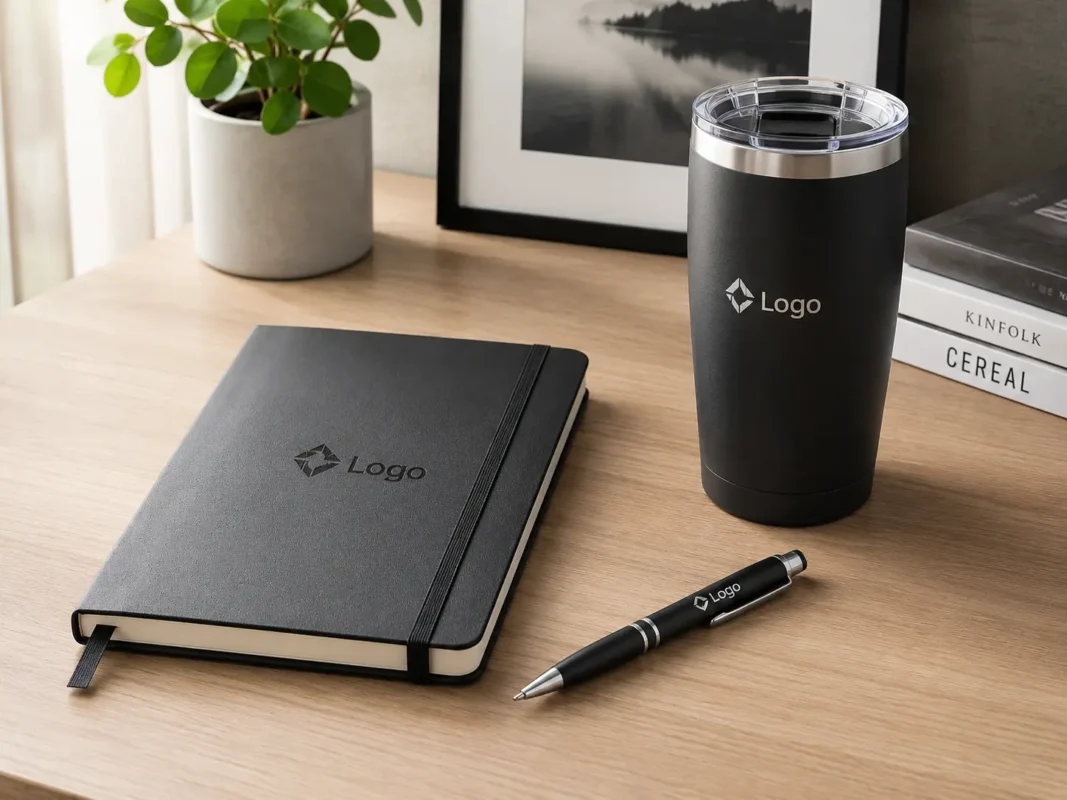
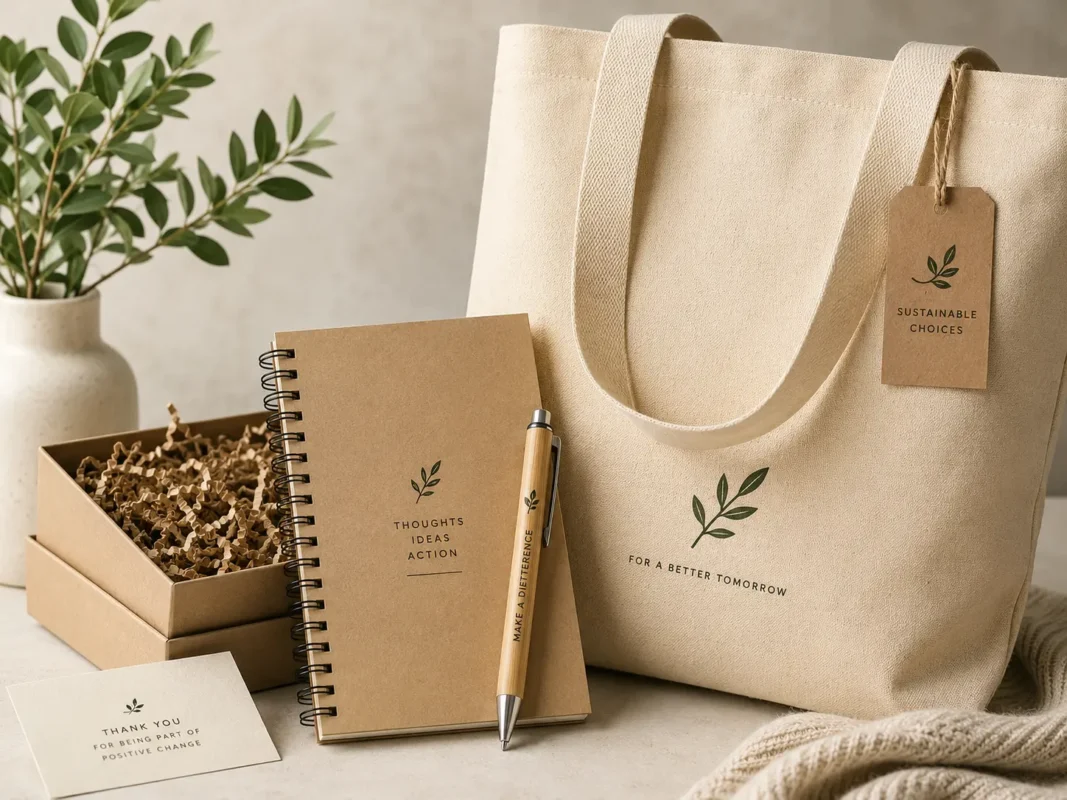
Reusable totes, recycled notebooks, bamboo cutlery, eco drinkware, and solar-powered gadgets carry a value story on top of their function – the sustainability angle genuinely resonates for CSR campaigns, sustainability-themed events, and any company trying to signal modern employer branding rather than a decade-old approach to swag. This isn’t a niche preference either: PwC’s Voice of the Consumer survey found nearly 45% of Saudi respondents are actively seeking more eco-friendly products, which makes this category a genuine reputational asset rather than a box-ticking exercise.
Print Me Factory’s Eco-Friendly Gifts category covers the writing instruments, notebooks, and drinkware side of this well, and the Promotional Bags range includes jute and cotton totes that carry a genuinely large imprint area – useful for anything that needs a bigger, bolder design than a pen barrel can hold.
The sustainability story only holds up if the item is still something people want. An eco-friendly gift that goes straight in a drawer is still waste – just waste with a better excuse. The strongest version of this category swaps the material without asking the recipient to sacrifice function – a bamboo pen that writes as well as a plastic one, a wheat-straw cup that holds up the same way a standard one does.
Luxury & Premium Gift Sets
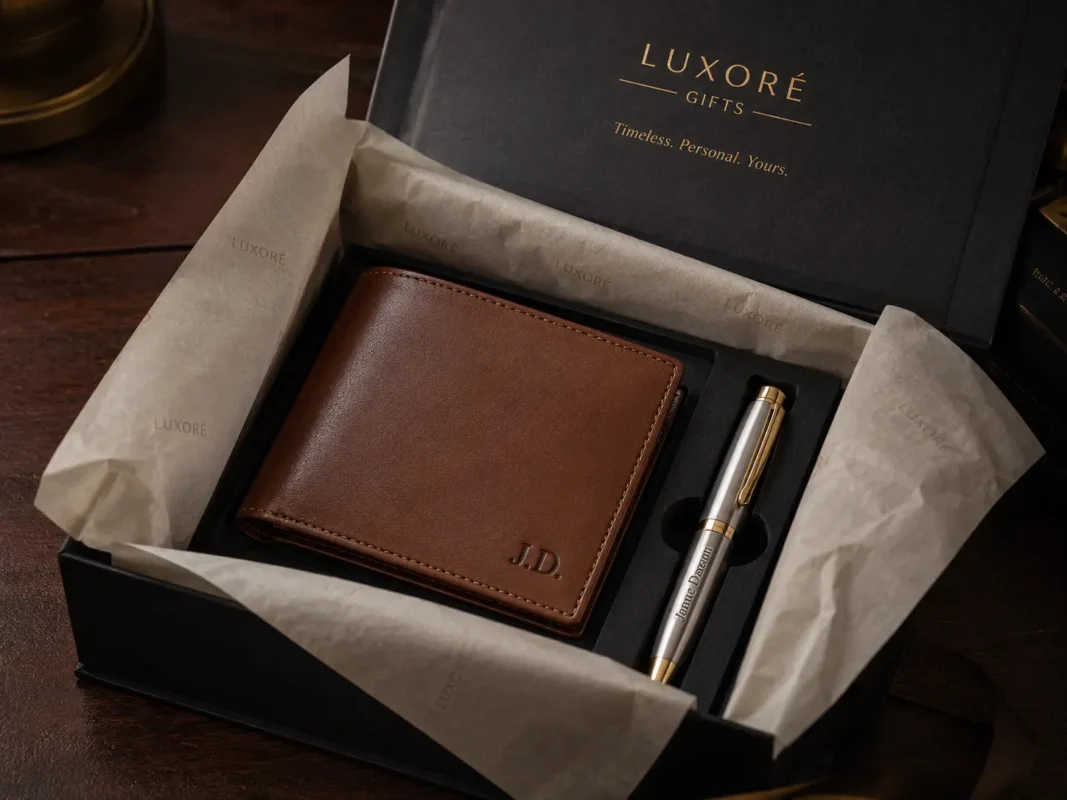
High-end gift boxes, travel items, leather accessories, and curated hampers belong to a much smaller slice of any gifting budget – reserved for top clients, executives, major milestones, and deals big enough that a generic giveaway would actually undersell the relationship.
Print Me Factory’s Custom Branded Gift Sets category is built for exactly this tier, combining a small number of well-chosen items into one coherent, boxed presentation rather than a scattering of separate pieces. Leather accessories – a Wallets range is a good example – sit comfortably in this bracket too, since a genuinely good wallet reads as a personal gift even with a small, tasteful brand mark.
Packaging and presentation matter more here than at any other tier. A premium item handed over in a plain bag undercuts itself; the same item in a well-designed box with a card reads as an entirely different gesture.
Restraint matters just as much as spend. A luxury gift set with six mismatched items reads as clutter no matter how much each individual piece cost – three or four items built around one clear theme signal that someone actually thought about the recipient, rather than emptying a warehouse shelf into a box.
Personalized & Experience-Based Giveaways
Engraved keepsakes, monogrammed accessories, custom artwork, and tailored desk pieces sit at the far end of the spectrum from bulk swag – these are chosen for one person, not printed for three hundred. Print Me Factory’s Key Holders and Awards and Plaques categories both fit this territory – a name engraved into metal carries a permanence that a printed logo simply doesn’t.
Experience gifts – event tickets, a class, a subscription, a curated box tied to someone’s actual interests – extend the same logic outside physical objects entirely. These cost more in thought than in riyals, and that’s exactly why they tend to deepen a relationship faster than a generic item ever could, regardless of category or price point.
This category doesn’t scale, and that’s the point. It’s meant for a short list – a retiring executive, a founding client, a long-serving employee – not a delegate bag at a five-hundred-person conference. Trying to personalize at that scale usually just produces a slower, more expensive version of a generic gift.
Choosing Giveaways for the Saudi Market
Category choice doesn’t happen in a vacuum, and Saudi Arabia has its own rhythm that’s worth building into the decision rather than bolting on afterward. Climate is the obvious one – insulated drinkware and portable tech hold up better through a Riyadh summer than almost anything else on this list, which is part of why those two categories consistently outperform in the region.
The business calendar matters just as much. National Day Products – scarves, notebooks, and keychains in respectful national colors – carry more weight than a standard giveaway precisely because they mark a specific, shared occasion rather than a generic year-round template. The same logic extends to Ramadan Gifts, where the tone should lean generous and warm rather than overtly commercial.
This lines up with broader Saudi gift-giving and hospitality customs, where presentation and genuine usefulness tend to carry more weight than an item’s price tag. Bilingual Arabic-English branding is worth defaulting to on notebooks, packaging, and signage rather than treating it as optional – it signals the gift was chosen for the market, not adapted from somewhere else at the last minute.
How to Choose the Right Type
Now the practical part. Four factors decide which category actually fits, in this order:
- Audience – employees, clients, prospects, or event attendees each expect a different tone and spend level.
- Occasion – an event giveaway, a holiday gesture, a milestone, and everyday appreciation all sit at different formality levels.
- Budget level – standard, mid-range, or premium; decide this before browsing products, not after falling for something nice.
- Desired impact – daily use, wow-factor, emotional connection, or a sustainability message each point toward a different category.
A quick example: a 500-person exhibition booth calls for office accessories or drinkware from Print Me Factory’s broader Promotional gifts range – inexpensive per unit, useful enough to survive the trip home. A single retiring executive calls for the opposite: one considered, personalized piece rather than anything pulled from a bulk order.
What to Avoid
Flimsy plastic items, over-branding, and zero-use novelty toys are where corporate gifting budgets quietly go to die. A stress ball shaped like a mascot might get a laugh at the table and land in the trash by the parking lot – and that gap between reaction and retention is the whole problem with novelty swag. Over-branding does similar damage in a quieter way: a logo that dominates the object turns a gift into an advertisement, and most people can feel that difference instantly, even if they couldn’t articulate why.
There’s real data behind sticking to useful categories over novelty ones. PPAI’s Product Power 2026 consumer study found 65% of people are likely to keep a branded item for six months or longer specifically when it’s durable, not because the item was clever or funny. Usefulness and build quality are the mechanism, not a nice bonus on top of it.
A simple rule cuts through most bad decisions before they happen: if you wouldn’t be happy to receive it yourself, don’t order it as a corporate giveaway. (Yes, that means skipping the ultra-cheap pen that already feels like it’s about to snap in half – it’ll be in the bin before the conference badge comes off.)
FAQs
What are the main types of corporate giveaways?
The core categories are office accessories and stationery, drinkware, food and beverage gifts, tech gadgets, branded apparel, eco-friendly products, luxury gift sets, and personalized or experience-based gifts.
Which giveaway types work best for events?
Office accessories, drinkware, and tote bags perform best at large events – they’re inexpensive per unit, easy to distribute, and genuinely useful during and after the event itself.
What types are best for employees vs clients?
Employees generally respond well to practical desk items, tech accessories, and eco-friendly gifts. Clients and executives warrant fewer, better items – luxury sets or personalized pieces rather than bulk swag.
Are eco-friendly giveaways worth the extra cost?
Usually yes, especially for CSR campaigns and modern employer branding, but only if the item is still genuinely useful. An eco-friendly gift nobody wants is still waste, just with better intentions.
Which giveaway categories feel premium?
Luxury gift sets, leather accessories, and personalized or engraved items feel the most premium, largely because of packaging, material quality, and the sense that the item was chosen specifically for the recipient.
How many types should a company focus on?
Most businesses do best sticking to two or three core categories – one for bulk event distribution, one for employee gifting, and one reserved for top clients or milestones – rather than spreading a budget across everything.
How do corporate giveaways impact brand perception?
A well-chosen, useful giveaway signals that a brand pays attention to quality and detail. A cheap or novelty item signals the opposite, regardless of how much the company actually spent on it.
Do corporate giveaways need to be different for the Saudi market?
Climate, the National Day calendar, and Ramadan and Eid gifting norms all shape which category performs best. Insulated drinkware, portable tech, and seasonally appropriate gift sets tend to outperform anything imported unchanged from a different market.


2 thoughts on “Types of Corporate Giveaways for Business”
Comments are closed.