


Short Answer: Proper corporate gifting etiquette in Saudi Arabia means choosing a modest, culturally appropriate, high-quality gift and presenting it at the right stage of the relationship. Ramadan, Eid, Saudi National Day, or after professional trust has developed are generally more suitable than an initial business meeting. Avoid alcohol, pork-related products, and gifts that feel overly personal. Safer choices include premium dates, Arabic coffee sets, perfumes, art books, and tastefully branded items. Present the gift with your right hand, use elegant packaging, and never make it feel tied to an obligation or expected favor.
Gift-giving in Saudi Arabia isn’t an accessory to hospitality – it’s one of the main ways hospitality gets expressed, in both personal and business settings. A well-chosen gift says something a handshake and a business card can’t quite manage: that the relationship is being taken seriously, not just the transaction attached to it.
Just how deeply gifting is woven into the calendar shows up in the numbers: Saudi Arabia’s Ramadan 2026 consumer season reached SAR 65 billion in total spending, up 12% from the year before, with gifting, clothing, and hospitality categories driving a large share of that surge. For a foreign visitor or a company opening its first office in Riyadh, this can feel disorienting – the line between “thoughtful gift” and “perceived bribe” is thinner here than in most Western business cultures, and getting it wrong carries real reputational and sometimes legal weight.
This guide walks through corporate gifting etiquette in Saudi Arabia properly – when to give, what to give, what to avoid entirely, and how to present a gift so it reads as respect rather than pressure. You’ll also see how the Corporate Gifts Saudi Arabia category most local suppliers organize their catalogs around lines up with the etiquette-safe categories covered below.
Cultural Foundations of Gift-Giving in Saudi Arabia
Hospitality and generosity sit near the center of Saudi social values, and gifts function as a kind of language within that framework – a way of communicating respect, gratitude, and good intentions without needing to say any of it directly. Islam shapes a good deal of the specifics: modesty, sincerity, and the avoidance of haram products (alcohol and pork chief among them) run through both personal and business gifting norms. Broader guides to Saudi Arabian business culture and etiquette consistently point back to the same handful of principles: patience, relationship-first negotiation, and a genuine respect for hierarchy that shows up in gifting as much as it does in meetings.
There’s a real difference between personal gift customs – the kind that show up in home invitations and close family circles – and formal corporate gifting, which carries more restraint and more attention to hierarchy. A useful way to picture the gap: a family friend might bring an elaborate, generous gift on a first home visit and it reads as warmth. A business contact doing the same at a first meeting can read as pushy, or worse, as an attempt to buy goodwill before any trust has been established.
Compare that to a gift offered after the third or fourth meeting, once genuine rapport exists – a small box of dates alongside a coffee set, handed over with a simple word of thanks. The item is nearly identical in both scenarios. The timing is what changes the meaning entirely.
When to Give Corporate Gifts in Saudi Arabia
Here’s the part people miss most often: avoid gifts at the very first meeting. It can feel premature, and in a worst case it raises exactly the kind of question you don’t want attached to a new relationship – what is this gift actually for?
Better moments include the end of a successful negotiation or contract signing, Ramadan and Eid (particularly mid-to-late Ramadan or the days around Eid itself), Saudi National Day on September 23 with respectfully themed items, and company anniversaries or major joint milestones. The relationship’s maturity matters more than the calendar date – a gift after real rapport has formed will always land better than the same gift offered too early.
- Safer timing: after a signed deal, during Ramadan/Eid, at National Day, on a joint anniversary.
- Riskier timing: the very first meeting, immediately before a decision is due, or during active contract negotiations.
Who to Gift, Hierarchy & Power Dynamics
Hierarchy matters more in Saudi business culture than many international visitors expect, and gifting patterns should respect it rather than cut across it. Handing an expensive personal gift straight to the most senior decision-maker in a room, while ignoring everyone else present, can read as an attempt to influence that one person specifically – not a great look, even with the best intentions behind it.
Gifts flowing upward, from an employee to a boss, carry a similar risk – they’re often read as an attempt to curry favor rather than a genuine gesture, and many Saudi companies quietly discourage the practice internally. The safer pattern is company-to-company gifting: a group gift for a delegation, or a team-level gesture, rather than a single expensive item aimed at one powerful person.
- Do this: gift at the company or team level; keep individual gifts modest and consistent across a delegation.
- Avoid this: a single lavish gift aimed at the most senior person in the room, or any gift that puts a decision-maker in an awkward position.
- Gender note: keep gifts to women or mixed groups professional and impersonal – perfume, jewelry, or anything intimate is safer left out of a business context entirely.
None of this means gifting has to feel stiff or overly clinical. A delegation of five visiting colleagues can each receive an identical, modest, well-made item – the equality itself is the etiquette. What reads badly isn’t generosity; it’s generosity aimed unevenly, in a way that singles someone out for reasons a room full of colleagues can quietly read between the lines.
Appropriate Corporate Gift Types in Saudi Arabia
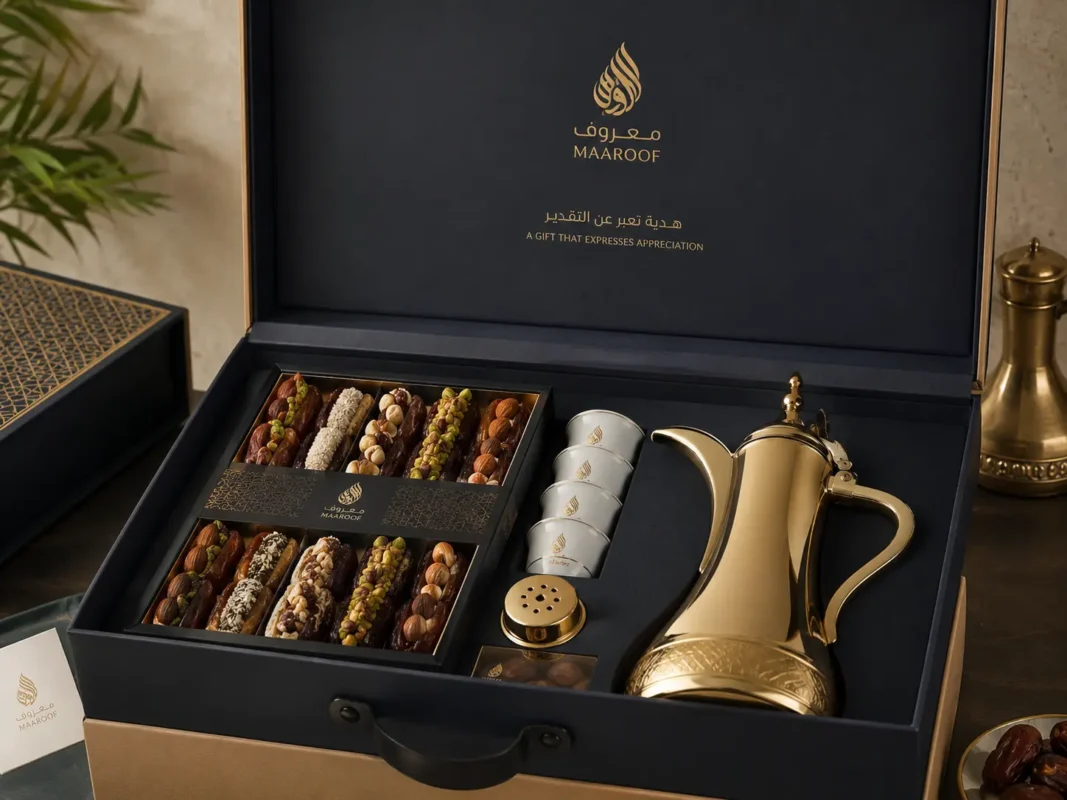
Luxury dates and Arabic coffee sets sit at the safest, most culturally rooted end of the spectrum – genuinely appropriate for Ramadan, Eid, National Day, or the close of a major deal, and rarely read as anything but thoughtful. Premium sweets and halal gourmet hampers work similarly, as long as everything inside is clearly halal-compliant.
Perfumes and oud-based scents are considered elegant and thoughtful when chosen with restraint – oud in particular carries genuine cultural weight in Gulf hospitality. Art books and cultural items, or a specialty product from your home country, work well for international visitors looking for something with a personal story attached rather than a generic logo.
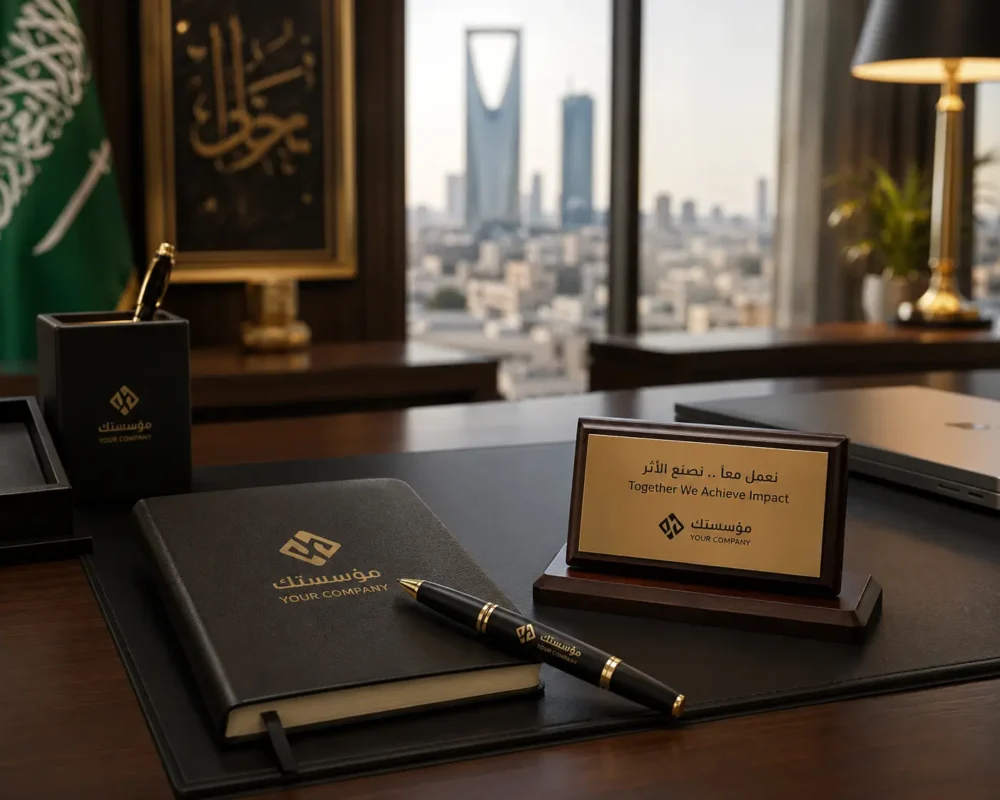
Tasteful branded merchandise – a well-made bottle, a leather-accented wallet, a discreet-logo notebook – fits comfortably here too, provided the branding stays subtle rather than dominating the object. Desk accessories and executive gifts round out the list: a Desk Items Sets organizer for daily use, or an Awards and Plaques style crystal piece for a genuine milestone – both read as status-appropriate when matched to the right occasion.
For anything bundled into a single box – dates, coffee, and a small stationery piece together – a Gift Sets style curated presentation tends to outperform the same items handed over separately.
Gifts to Avoid or Handle Carefully
Alcohol and pork products are an absolute no – they conflict directly with Islamic norms and there’s no context in Saudi business culture where they read as acceptable. Knives and anything weapon-like should generally be avoided too, regardless of how elegant the craftsmanship (a beautiful letter opener can still land the wrong way).
Overly personal gifts – intimate clothing, very personal jewelry, anything with romantic imagery – have no place in a corporate context. Politically or religiously charged items are worth avoiding entirely, even ones that seem harmless from outside the region. And very expensive gifts, especially toward government officials or regulated industries, risk being read as an attempt to influence a decision rather than a gesture of goodwill.
This is where internal compliance and cultural practice can pull in different directions, and it’s worth checking both your own company’s anti-bribery policy and, where relevant, the recipient’s before committing to anything above a modest value. When in doubt, a good rule of thumb: if you’d feel uncomfortable disclosing the gift to your own compliance team, that discomfort is the answer.
Presentation, Wrapping & How to Give the Gift
The right-hand rule matters more than most first-time visitors expect: gifts should be given and received with the right hand, or both hands together – the left hand alone reads as impolite, a holdover from older hygiene customs that still shapes etiquette today.
Wrapping should stay elegant, minimal, and conservative – this is one area worth spending a little more on, since packaging genuinely changes how a gift is perceived before it’s even opened. When you hand it over: a warm smile, a short, sincere word of appreciation, and absolutely no hard sell attached to the moment.
Don’t expect the gift to be opened immediately – in many Saudi business contexts, recipients set gifts aside to open later, privately, rather than unwrapping them in front of the giver. Don’t read that as disinterest, and don’t push for an on-the-spot reaction. For group settings, hand gifts to each person individually rather than to one representative, unless local colleagues specifically advise otherwise for that delegation.
One more detail worth knowing: complimenting an object openly in some Gulf social settings can prompt the owner to offer it to you as a gift on the spot, out of pure generosity. It rarely comes up in a boardroom, but it’s worth being aware of during hospitality-heavy visits – a office tour, a home dinner tied to a business trip – so an offhand compliment doesn’t turn into an obligation neither side actually wanted.
Religious & Seasonal Etiquette
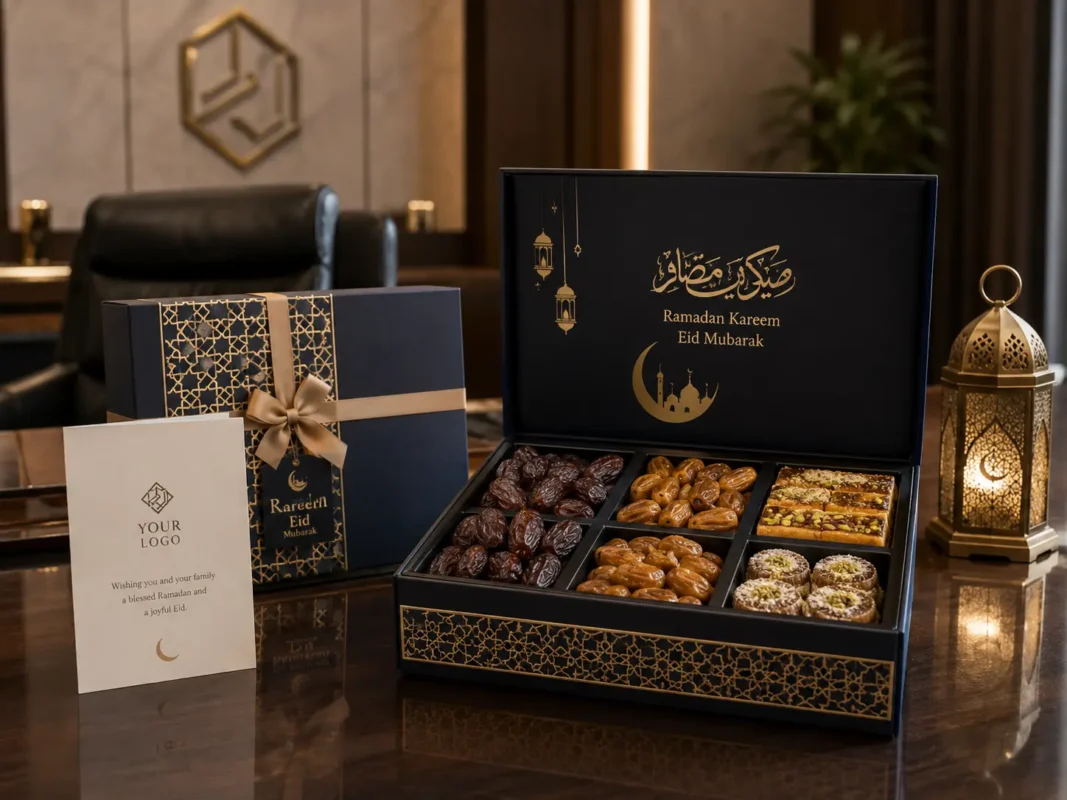
Ramadan and Eid gifts should reflect the season’s spiritual and family-oriented character – dates, coffee sets, sweets, and thoughtful wellness items all fit naturally, while anything overtly commercial or promotional feels slightly out of place. Be mindful of fasting hours too: pushing food or drink on a colleague during the day, even with good intentions, misreads the moment entirely.
Saudi National Day Products gifting can lean into national colors and respectful motifs, but restraint matters – overcrowding a gift with flags and symbols reads as trying too hard rather than genuinely celebratory. The same logic extends to Ramadan Gifts, where a calm, generous tone consistently outperforms anything that feels like a sales campaign wearing a holiday theme.
Handling Bribery & Policy Concerns
Some Saudi companies restrict gifting outright, specifically to avoid any perception of bribery or favoritism – and that caution isn’t paranoia. Saudi Arabia scored 57 out of 100 on Transparency International’s 2025 Corruption Perceptions Index, ranking among the highest scorers in the MENA region but still low enough that companies operating there take bribery concerns seriously in their internal policy. A gift that looks generous to one side of a relationship can look like a compliance problem to the other.
Safe practice starts with keeping gift value moderate and consistent, rather than escalating for whoever holds the most influence in a room. Favor group gifts over individual gifts to powerful decision-makers, and document anything above a reasonable threshold for internal transparency. If a gift conflicts with policy, decline it politely and specifically – “our company policy limits gifts above a certain value” is a clear, respectful, and entirely acceptable answer that doesn’t require further explanation.
Accepting Gifts Graciously
Outright refusing a gift can read as offensive unless there’s a clear, statable policy reason – accept with genuine gratitude, using the right hand or both hands, and say so plainly. If your company has a policy of sharing gifts within a team rather than keeping them individually, it’s fine to mention that briefly, without turning it into an awkward moment for the person who gave it.
Visitors sometimes find themselves on the receiving end of gifts more generous than their home-country policy allows. In that case, accept graciously in the moment, then follow up privately and diplomatically afterward if a return or donation is genuinely required – handling it in front of the giver rarely goes well for either side.

FAQs
Is it expected to give corporate gifts in Saudi Arabia?
It’s common and appreciated, especially around Ramadan, Eid, and National Day, but it isn’t a rigid obligation at every meeting. A well-timed gift after a relationship has formed carries far more weight than a routine one at every interaction.
What are safe corporate gift ideas for Saudi business partners?
Luxury dates, Arabic coffee sets, halal sweets, quality perfumes or oud, art books, and tastefully branded desk items or drinkware are all safe, well-regarded choices.
When is the best time to give business gifts in KSA?
After a successful negotiation, during Ramadan or Eid, around Saudi National Day, or at a genuine milestone. Avoid the very first meeting, which can feel premature.
Which items are considered inappropriate or offensive as corporate gifts?
Alcohol, pork products, knives or weapon-like items, overly personal or intimate items, and anything politically or religiously charged should all be avoided.
How can I avoid my gift being seen as a bribe?
Keep the value moderate, favor group or company-level gifts over individual gifts to senior decision-makers, and time the gift after a decision has already been made rather than before one.
Should I include my company logo on corporate gifts in Saudi Arabia?
A small, discreet logo is fine and even expected on branded merchandise. A logo that dominates the item can make the gift feel more like an advertisement than a genuine gesture.
Are gifts between employees and bosses common in Saudi companies?
They’re less common than company-to-company or team-level gifting, and many organizations quietly discourage upward gifting since it can be read as an attempt to curry favor.
How do corporate gifting norms differ between Saudi Arabia and other GCC countries?
The core principles – modesty, right-hand presentation, avoiding alcohol and pork – hold across the Gulf, but Saudi Arabia tends to apply them more conservatively than neighbors like the UAE, particularly around timing and gender-related gifting.


6 thoughts on “Corporate Gifting Etiquette in Saudi Arabia”
Comments are closed.