
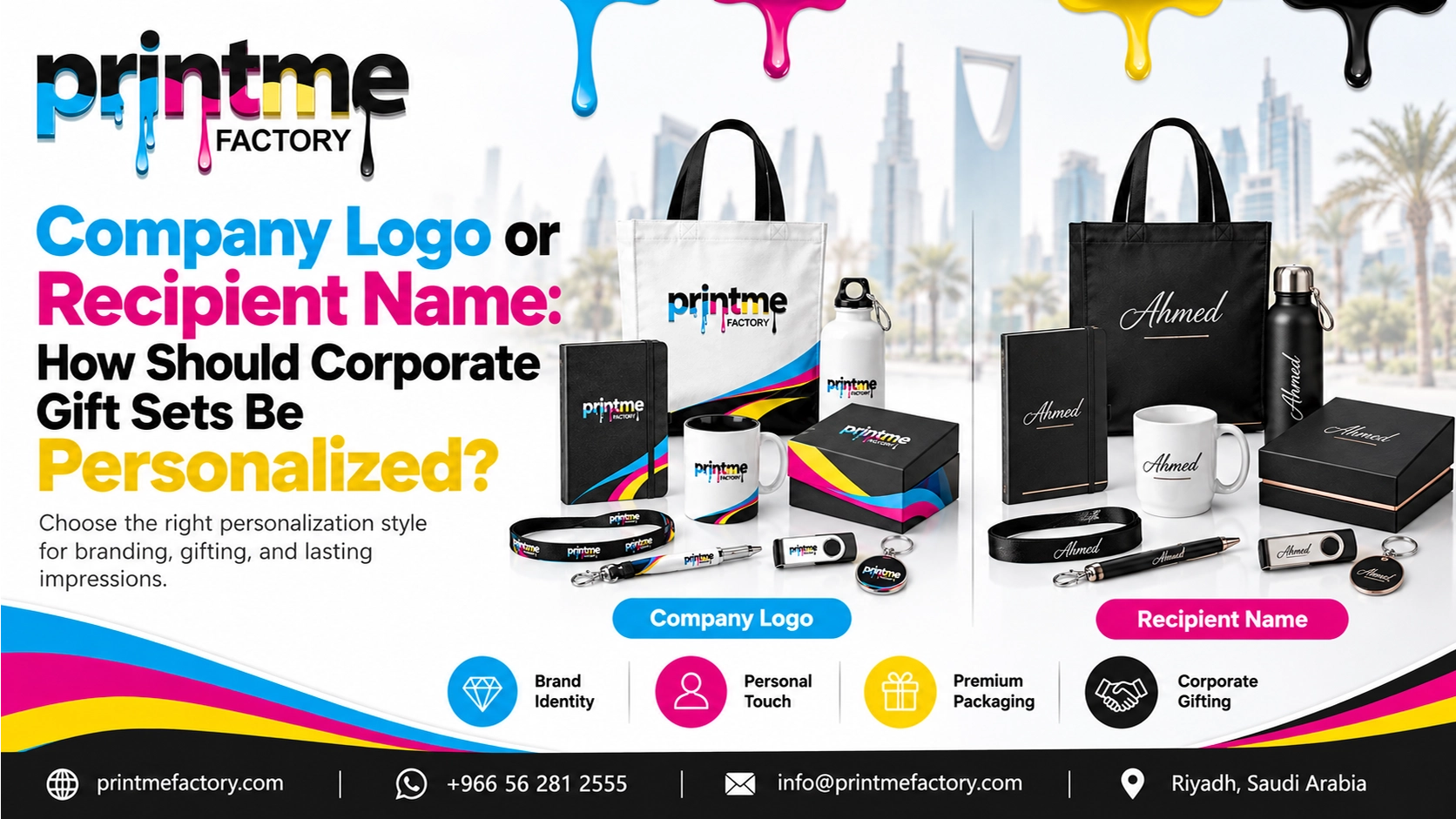
Quick answer: Neither option wins outright – the strongest Saudi corporate gift sets use both, split by role. The company logo belongs on the packaging and the shared, visible pieces (the box lid, a desk tray, a card holder), while the recipient’s name belongs on the personal item they will keep – a pen, a notebook cover, a keychain, a leather folio. This hybrid split protects brand visibility without making the gift feel like a giveaway, and it is the approach we default to on the factory floor for most Saudi Gift Sets ordered for executives, new hires, and VIP clients.
A Riyadh-based procurement manager called our Jeddah factory last quarter with a file of 40 executive names, a deadline nine days out, and one open question: logo or name? It is the same call we get almost every week, from government-adjacent entities ordering leadership gifts to a small marketing team putting together its first National Day set. The instinct is to treat it as a design preference. On the factory floor, it is really a production decision with cultural stakes attached – get it wrong and a six-figure gifting budget ends up looking like it was pulled off a shelf.
Saudi Corporate Gifts in Saudi Arabia culture leans heavily on fakhama (فخامة) – a sense of prestige and generosity that shows respect for the recipient, not just the brand sending the gift. Walk into a Riyadh boardroom or a Jeddah family business office and the instinct runs the same way it does at a wedding or a majlis: the gift has to look like it was chosen for the person in front of you, not mass-produced for whoever happened to be on the list. A logo-only set can read as corporate overhead; a name-only set can look like it forgot who paid for it. Getting the split right is less a matter of taste and more a matter of understanding how Variable Data Printing (VDP), Arabic-English name accuracy, and real production timelines interact once the order actually hits the engraving bed.
We have run this decision through hundreds of Saudi corporate orders – National Day leadership sets, new-homeowner handover kits, onboarding boxes for Riyadh and Eastern Province offices – and the pattern repeats almost every time: the companies that plan the logo-versus-name split before they request a quote end up with a gift that photographs well and holds up under daily use. The ones that leave it to the supplier to guess usually end up re-ordering.
Comparison: Personalization Strategy at a Glance
| Personalization Strategy | Best For | Brand Placement | Recipient Perception | Production Complexity |
|---|---|---|---|---|
| Logo Only | Mass events, onboarding kits, trade shows | Visible on every item | Feels corporate, slightly impersonal | Low – one setup, one run |
| Name Only | Close team gifts, small personal tokens | Minimal or absent | Feels personal, brand gets lost | Medium – VDP needed per piece |
| Hybrid (Logo + Name) | VIP clients, executives, National Day sets | Logo on box/shared item, name on personal item | Feels prestigious and thoughtful | Higher – two processes, tighter QC |
| Logo on Packaging Only | Gifts shipped to recipient’s home or office | Box only, item left clean | Feels premium, understated | Low-Medium – packaging branding only |
The Cultural Weight Behind the Decision: Fakhama and the Saudi Gifting Mindset
In the Gulf, a gift is read as a statement about how much the giver values the relationship – not just a marketing touchpoint. That is why fakhama (فخامة, loosely “prestige” or “magnificence”) shows up constantly in how Saudi executives brief their gifting programs: the item has to look like it was chosen for them, not pulled off a shelf of a thousand identical units.
This cultural backdrop is also showing up in the numbers. Saudi Arabia is now one of the few countries in the world recording a net inflow of wealthy residents rather than an outflow – Saudi Arabia was set to see a 700% surge in millionaire inflows in 2025, according to Henley & Partners’ 2025 wealth migration research, which placed the Kingdom among the top global destinations gaining high-net-worth individuals that year, part of a worldwide pool of roughly 142,000 relocating millionaires. That inbound executive and investor class is exactly the audience that notices whether a gift set was personalized with genuine care or simply logo-stamped in bulk.
For this audience, a plain laser-cut logo on an off-the-shelf pen reads as an afterthought. A gift set where the recipient’s name is engraved in correctly rendered Arabic script, inside packaging that carries the company’s branding with restraint, reads as something considered. The hybrid approach exists precisely to serve both audiences in the room at once: the company that is paying, and the person receiving.
Strategy 1: Logo-Only Personalization
Logo-only is the default for anything produced at volume. If you are ordering 300 onboarding kits or a batch of giveaways for a conference booth, there is no practical way to engrave 300 individual names without extending the production schedule and the budget well beyond what the occasion justifies.
- Works best for: trade show giveaways, new-employee welcome kits, bulk client mailers, National Day distribution gifts.
- Production reality: one artwork setup, one engraving or printing run, fast turnaround – this is the cheapest and most predictable path.
- Where it falls short: for a VIP client or a long-tenured employee, a logo-only item can feel like it was pulled from the same box as everyone else’s – because it was.
Here on the factory floor, logo-only runs are the easiest jobs we process. The artwork is approved once, the laser or UV-DTF settings are locked in, and the line moves. The trade-off is entirely about perception, not production – and that trade-off matters more in Saudi Arabia than in markets where branded swag is treated as disposable.
Strategy 2: Name-Only Personalization
Name-only sits at the opposite end. It is the right call for a small, high-touch batch – a leadership team of eight, a handful of retiring staff, a short list of referral partners – where the company’s identity is already established through the relationship, and the point of the gift is to make the person feel individually recognized.
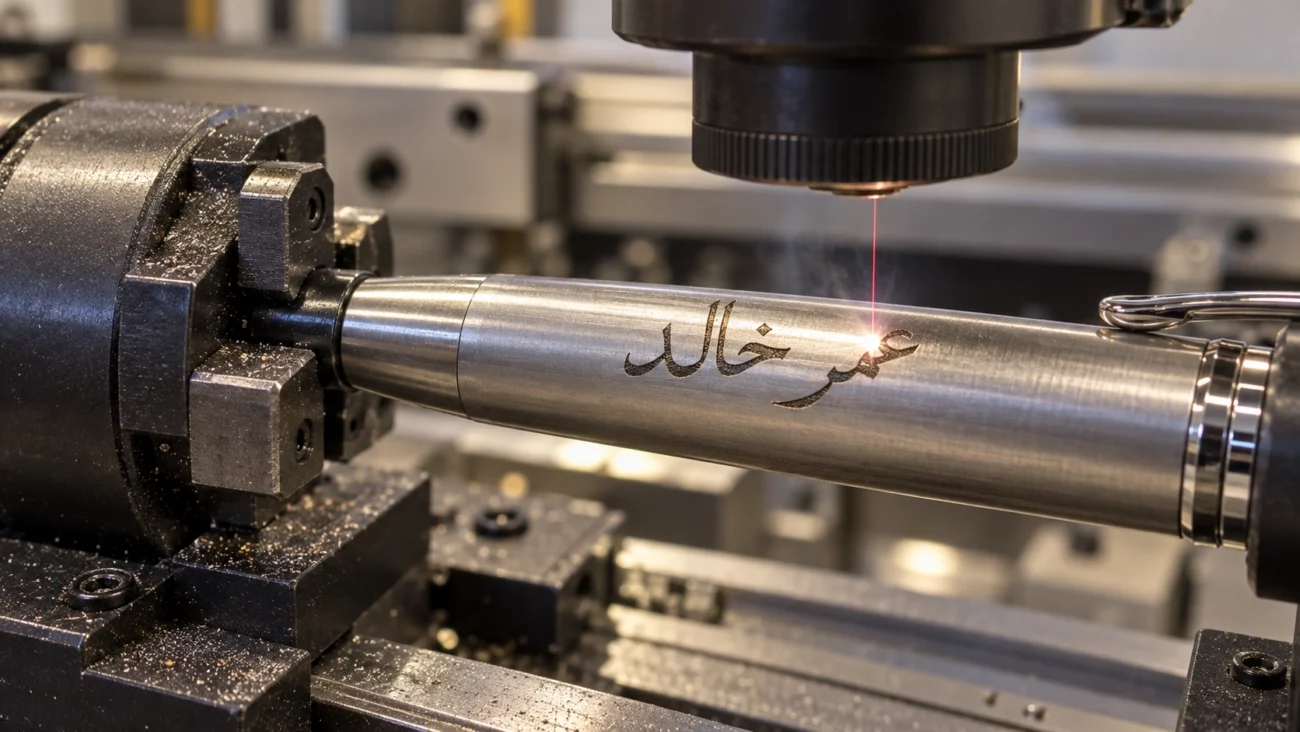
The production reality changes completely here. Every piece needs its own file, pulled from a spreadsheet of names rather than one static logo file. This is where variable data printing (VDP) comes in: a technique that lets a laser or digital printer swap the text on every single unit in a batch without a new manual setup each time. It is efficient once configured, but configuring it correctly for Arabic names is the step most overseas or inexperienced suppliers get wrong.
The Arabic Name Problem Nobody Talks About
Arabic script is contextual – the shape of a letter changes depending on whether it sits at the start, middle, or end of a word, and whether it connects to the letters beside it. A font file that renders a name correctly on a screen can still misconnect letters once it is converted to a vector path for engraving, especially with compound names or titles. We have had to re-run batches because a name that looked fine in the proof had a disconnected ع or ه once it hit the engraving bed at a smaller scale. The fix is always the same: proof every name at actual production size, not at a zoomed-in screen resolution, and have a native Arabic speaker check the final file before the run starts – not after.
- Works best for: executive gifts, retirement or farewell sets, small partner lists, individually addressed client mail.
- Production reality: VDP file prep per name, mandatory Arabic proofing step, slower turnaround than logo-only.
- Where it falls short: the sender’s brand can disappear entirely if there is no packaging or accompanying card to carry it.
Strategy 3: The Hybrid Approach (Logo on Packaging, Name on the Item)
This is the approach we steer most VIP and executive orders toward, and it is the one we come back to on almost every leadership or client-facing set that leaves the Jeddah factory. The logic is simple once it is laid out: the box is what the company controls and what travels through an office, a lobby, or a photo – so the logo belongs there, understated and well placed. The item inside is what the person actually uses for the next several years – so their name belongs there, not the company’s.
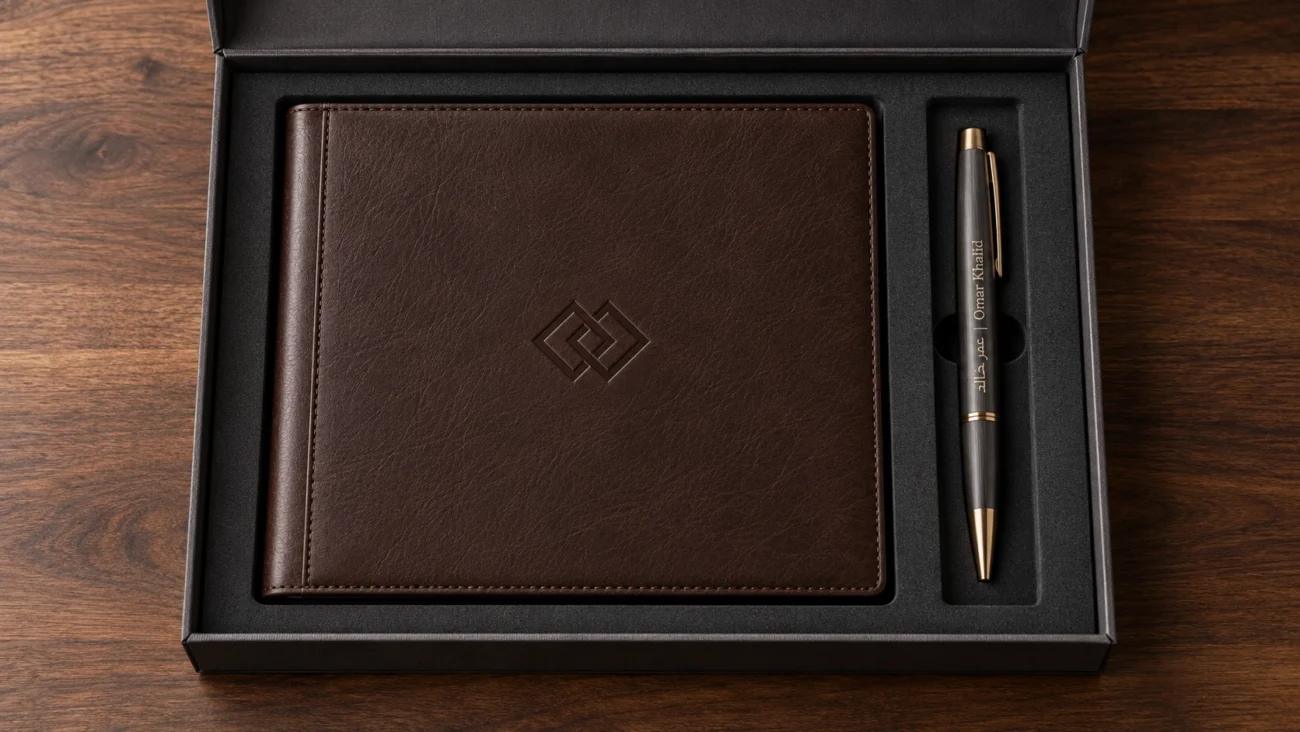
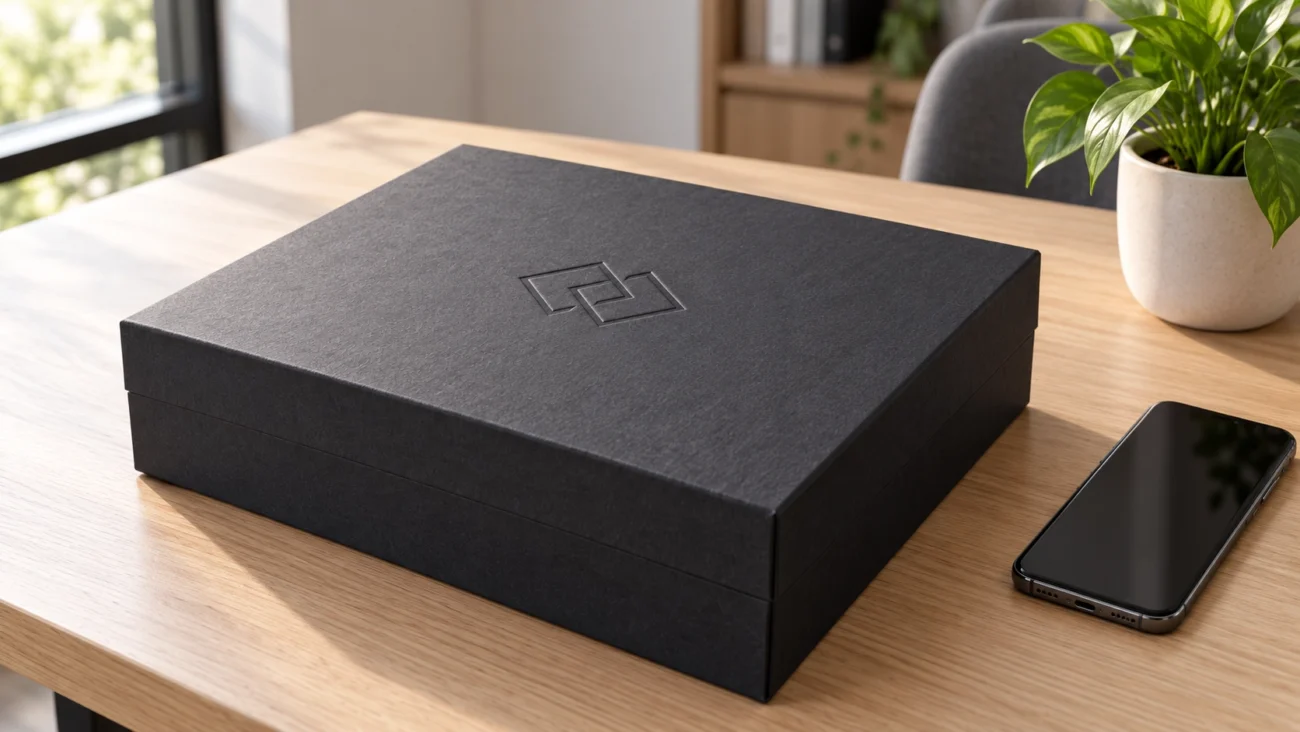
A typical hybrid set we build: a rigid, magnetic-close presentation box with the company’s logo blind-debossed or foil-stamped on the lid (never full-color, never oversized), containing a leather-bound gift-set piece such as a notebook or document folio, plus a smaller personal item – a pen, a custom keychain – individually laser-engraved with the recipient’s name in Arabic, English, or both, depending on their preference.
One common mistake we still see from clients ordering direct: they ask us to put the logo and the full name on the same small surface – say, a keychain barely four centimeters wide. The result is cramped, illegible at normal reading distance, and undermines the premium feel the client was trying to create in the first place. The fix is almost always to let the box carry the logo and keep the item itself to one message only.
- Works best for: VIP clients, senior executives, National Day leadership gifts, long-tenure staff recognition.
- Production reality: two separate processes running in parallel – bulk logo branding on packaging, individual VDP engraving on the personal item – so timelines need to account for both.
- Where it excels: it is the only strategy that keeps the brand visible without making the personal item feel branded.
The Factory Reality: What Actually Drives the Decision
Away from the design brief, three practical factors end up deciding which strategy a company actually ends up using, more than preference does.
1. Batch Size and Timeline
Logo-only scales almost infinitely within a normal production window. Name-only and hybrid runs scale in direct proportion to how clean the name list arrives – a tidy spreadsheet with correctly spelled Arabic and English names cuts the proofing stage dramatically; a messy list pulled from several HR systems adds days.
2. The Local Printing and Engraving Capacity Behind It
Saudi Arabia’s own production capacity for this kind of work has been expanding quickly. Saudi Arabia now accounts for just over half the entire GCC digital printing market – Saudi Arabia’s share of the GCC digital printing market, per Mordor Intelligence, which put the Kingdom at 52.12% of regional digital printing revenue in 2025, inside a GCC market valued near USD 0.89 billion in 2026 and growing at roughly 8.6% a year through 2031, largely on the back of Vision 2030 construction and corporate activity. That local capacity is exactly what makes fast-turnaround VDP and in-house engraving realistic for Saudi gifting programs, instead of waiting weeks for work to be done overseas.
3. Material Choice
Leather and wood hold a debossed or laser-etched logo cleanly for years. Softer plastics and some anodized metals do not – the mark can fade or scratch with handling, which matters for an item someone carries daily. We steer clients away from full-color printed logos on anything that will live in a pocket or bag, for exactly this reason.
Why This Is Getting More Attention Now
Part of why procurement teams are now briefing suppliers this specifically on personalization, rather than simply ordering “the usual branded pens,” is that the broader incentive and gifting economy in Saudi Arabia is scaling up fast. Saudi Arabia’s gift card and incentive market was valued near USD 4.2 billion in 2026 and is projected to grow at a 12.3% annual rate through 2034, per IMARC Group – a pace that reflects how much more structured and frequent corporate recognition and client-gifting programs have become across the Kingdom. A market growing that quickly is also one where recipients compare notes, so a generic, unpersonalized gift stands out for the wrong reasons.
Matching Personalization to Occasion
The right strategy also depends heavily on what the gift is marking. Good gifting etiquette in Saudi Arabia treats a wedding congratulations gift or a condolence gesture very differently from a corporate campaign gift – the former calls for restraint and almost always favors name-only or no visible branding at all, while a National Day activation or a product launch leans logo-first because the goal is visibility, not intimacy. Recognizing which goal is in play before briefing a supplier avoids the awkward middle ground where a gift tries to do both jobs badly.
It is also worth separating this personalization question from the broader promotional vs. corporate gifts distinction. A mass-distributed promotional gifts giveaway – the kind handed out by the hundreds at a Riyadh trade show booth or a Jeddah mall activation – is almost never a candidate for name personalization; the volume and budget simply don’t support it. The logo-versus-name decision described in this article applies specifically to corporate gift sets going to a defined, smaller list of recipients, not to bulk event swag.
Procurement Checklist: Briefing a Supplier on Personalization
- Decide the split before requesting quotes: logo on packaging, name on the item, or logo-only for volume – don’t leave it open for the supplier to guess.
- Supply a clean, verified name list in a single spreadsheet, with Arabic and English spellings confirmed by the recipients themselves where possible, not transliterated internally.
- Request a physical name-engraving proof on the actual item material before approving the full run – a screen proof is not enough for Arabic script.
- Confirm which branding method suits the material: blind debossing or laser engraving for leather and wood, laser engraving for metal, UV-DTF for full-color packaging graphics.
- Build in extra lead time for VDP and hybrid runs compared with a straight logo-only batch – two processes rarely finish on the same day as one.
- Keep the logo and the name off the same small surface; let the box or an accompanying card carry the brand instead.
FAQs
Should a corporate gift always have the company logo on it?
No. For VIP or executive gifts, it is often stronger to keep the logo on the packaging only and leave the personal item clean except for the recipient’s name – the brand still gets seen without overpowering the gift.
Can Arabic and English names both be engraved on the same item?
Yes, on items with enough surface area – a pen barrel, a notebook cover, a keychain tag. The key is proofing both scripts at true production size beforehand, since Arabic letterforms can distort more than Latin ones when scaled down.
Is logo-only personalization cheaper than name-only?
Generally yes, because logo-only needs a single setup for the whole batch, while name-only requires a unique file per recipient through variable data printing, plus a dedicated Arabic proofing step.
What is the biggest mistake companies make when personalizing gift sets?
Cramming both the logo and a full name onto one small surface, which makes both illegible. Splitting the branding between the packaging and the personal item almost always looks more premium.
Which materials hold a personalized engraving best over time?
Leather, wood, and most metals hold a debossed or laser-etched mark cleanly for years. Softer plastics and some printed finishes wear faster with daily handling, so they’re a weaker choice for anything carried or used often.
How far in advance should a company plan a hybrid personalization order?
Build in more time than a standard logo-only run, since packaging branding and individual name engraving are two separate production steps that need to be scheduled and quality-checked separately rather than run together.
Does personalization style change for a Saudi National Day gift versus an everyday client gift?
Often, yes. National Day sets tend to lean logo-forward to carry a shared campaign identity, while year-round client or executive gifts lean toward the hybrid or name-first approach to feel more individually considered.


2 thoughts on “Company Logo or Recipient Name: How Should Corporate Gift Sets Be Personalized?”
Comments are closed.