

Short Answer: The best welcome gifts for new clients and business partners combine something practical, something personal, and sometimes a small treat. A quality notebook, drinkware, or desk accessory paired with a handwritten note feels more thoughtful than a generic branded giveaway. Timing matters too – sending the gift a few days after signing often feels more natural than handing it over the moment the contract is finalized. Keep the value appropriate to the relationship and make sure the gift feels selected for that specific client or partner rather than reused from a standard promotional campaign.
The first few weeks of a new client or partner relationship set the tone for everything that follows. A thoughtful welcome gesture doesn’t buy loyalty – it reinforces something the client already believes, which is that choosing to work with you was a good decision. That reinforcement matters more than most sales teams give it credit for.
The stakes behind that early window are real. OnRamp’s 2026 State of Onboarding report found that 57% of companies who cut onboarding investment saw churn increase within six months, and the first weeks of a relationship are exactly where that investment either shows up or doesn’t. A welcome gift is a small, low-cost piece of that investment – not the whole strategy, but a genuine signal that the relationship is being taken seriously from day one, not just during the sales process.
This piece covers welcome gift ideas for new clients and business partners properly – timing, budget, who should actually receive one, and specific ideas for both categories. A good starting point for browsing options sits in a broad Customized Corporate Gifts KSA collection, which covers most of the practical categories this guide walks through. None of it requires a large budget or a design team – it requires a repeatable process and a bit of restraint.

Timing – When to Send a Welcome Gift
Here’s the timing mistake most teams make: sending the gift the exact moment the contract is signed. The client is already on a high from making the decision, and the gift competes with that excitement instead of adding to it – it arrives as noise during a moment that’s already full.
The better window is a few days to a week after signing, once the initial excitement has settled into something calmer. A gift landing in that gap re-ignites the good feeling rather than getting lost inside it. For longer implementations, a second touchpoint at a meaningful milestone – kick-off, first value delivered, the halfway point of a project – extends the warmth well past the initial signature.
Business partnerships run on a slightly different clock than client onboarding. Align gifts with the formal agreement signing, the first joint project launch, or a genuine anniversary of the partnership – moments that mark real progress rather than an arbitrary calendar date.
There’s a practical reason the delayed approach works better, beyond just avoiding the noise of signing day. A gift that arrives a week later signals ongoing attention rather than a one-time transactional gesture baked into the sales process – it says someone thought about this after the deal closed, not just as part of closing it.
Who Should Receive the Gift
Decide early whether the gift goes to one primary contact – the executive sponsor who signed – or to the whole implementing team. A small item sent to every person who’ll actually work with you day to day often builds more goodwill than one larger gift aimed at a single decision-maker, simply because more people feel seen.
For business partners, consider gifting both the decision-maker and the operational team handling the partnership on the ground – the people doing the actual work rarely get thanked directly, and a small gesture toward them stands out precisely because it’s rare.
When sizes, dietary preferences, or delivery addresses aren’t known, use a recipient-choice link rather than asking for personal details directly. It respects people’s time and avoids the slightly awkward feeling of a vendor requesting a home address before the ink on a contract is even dry.
A quick gut check that settles most edge cases: if you removed the executive sponsor from the deal tomorrow, would the operational team still be the people making the relationship work day to day? If yes, they deserve to be on the gift list too, not just an afterthought mentioned in a thank-you email.
Budget Guidance – How Much to Spend
Proportionality is the whole game here. A few practical bands:
- New or small clients: a modest gesture, often in a lower price bracket – the gift should feel considered, not expensive.
- Mid-market or renewing clients: something more considered, occasionally including a treat like coffee or a small indulgence.
- Major partners or enterprise deals: premium but still tasteful – anything that could read as an inducement rather than gratitude works against you, especially with government-adjacent or regulated clients.
Many teams settle on a flat “safe” spending cap per person to keep gifting proportional and policy-compliant across the board, regardless of deal size. It’s worth reviewing this alongside broader Corporate Gifting Etiquette in Saudi Arabia guidance, since the line between a generous welcome gesture and something that reads as an attempt to influence a decision-maker is thinner than most teams assume – particularly for larger accounts or public-sector-adjacent clients.
A useful test when a gift feels borderline: would this look fine written up in a company newsletter, with the client’s name attached? If the honest answer is a wince rather than a shrug, the spend is probably a notch too high for the relationship it’s meant to open.
What Goes Into a Great Welcome Gift
- A wearable – subtle, well-made apparel people will actually use, not just store in a drawer.
- A desk item – something useful and good-looking that stays visible on a desk for months, not days.
- A treat – coffee, tea, or a small indulgence that turns branded merchandise into an actual moment.
- A handwritten note – this does the personalization work for the entire box, so nothing else needs to be individually customized.
- Packaging that pops – a well-designed, colorful box travels through the whole office and becomes a talking point on its own, before anyone’s even opened it.
Welcome Gift Ideas for New Clients
- Branded notebook or planner – from a Notebooks range, ideally with a name or short message on the cover. Works because it gets reached for daily, not just admired once.
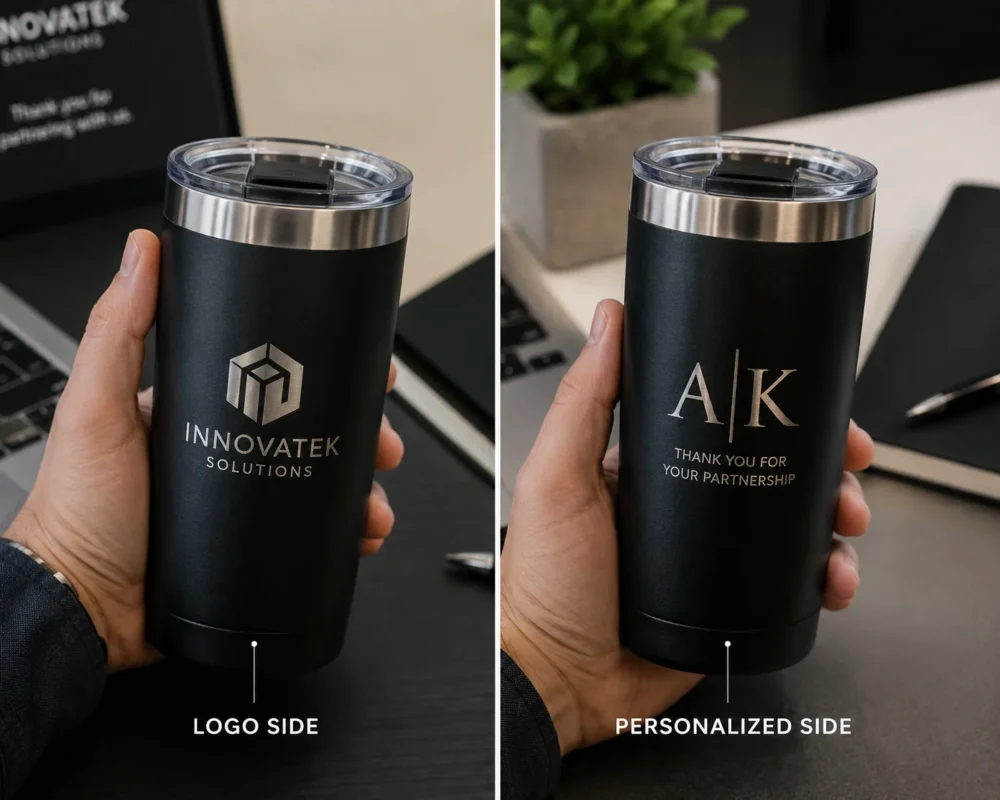
- Premium drinkware – a quality Drinkwares piece, logo on one side and initials on the other if personalization budget allows. Shows up in every meeting, which is exactly the point.
- Desk accessories – pen holders, wireless chargers, or an elegant paperweight from a Desk Items Sets range add polish to a workspace without feeling excessive.
- Coffee or tea gift set – gourmet beans or artisanal tea paired with a stylish mug turns an ordinary office break into a small welcome moment.
- Eco-friendly gift set – reusable bottles, bamboo organizers, or seed-paper notebooks from an Eco-Friendly Gifts range signal shared values without saying a word about it.
- Business card set or luxe stationery – a Wallets piece or a smart card holder makes an account handover feel more human, less transactional.
- Snack or gourmet box – curated local treats or premium nuts work as a warm, low-effort welcome touch when a full gift set feels like too much too soon.

Welcome Gift Ideas for Business Partners
Partner-level relationships often call for a slightly more formal or industry-tailored approach than a standard client welcome box – the business relationship here is usually longer-term and more strategic, and the gesture should read that way.
- Industry-tailored gifts – a golf-themed kit for finance partners, a travel pack for mobility-focused partners. Specificity beats generosity here.
- Co-branded items – products carrying both companies’ branding, which quietly symbolizes the partnership itself rather than one side gifting the other.
- Premium hampers or curated boxes – a Gift Sets style mix of gourmet food, drink, and lifestyle items for a more elevated welcome than a standard client box.
- Books or thoughtful keepsakes – something tied to shared goals or values, occasionally with a symbolic twist worth explaining in the accompanying note.
- Experience-based gestures – a shared meal, an event invite, or a small celebration marking the start of the partnership does more relationship work than any physical object could.

Personalizing Without Overcomplicating
You don’t need to customize every single item in the box – the handwritten note does most of the personalization work on its own. Reference something specific: the client’s industry, a detail from your first conversation, or the goal they mentioned during the sales process. That one sentence does more than an engraved logo on every item ever could.
Avoid over-personalizing at scale, which quietly turns a repeatable process into a bespoke one nobody has time to sustain. Standardize the box design instead, then let the note and one tailored item carry the personal weight. This is the same logic that separates a genuine corporate gift from mass promotional swag – the thought has to land somewhere specific, it just doesn’t need to land everywhere at once.
The note itself doesn’t need to be long. Two or three sentences that reference something real – a phrase the client used in the first call, the specific problem they hired you to solve, a shared goal for the first quarter – do more relationship work than a paragraph of generic warmth ever will. Specificity, not length, is what makes it land.
Making It Repeatable, Not a One-Off Scramble
The best welcome-gifting programs are standardized boxes triggered by a clear event – contract signed, onboarding kicked off – rather than something an account manager has to remember to do manually between fifteen other tasks. A simple workflow works: define the trigger, assign an owner, set a budget cap, automate shipping or use a recipient-choice link, and track who’s already been sent one.
Assigning a single owner matters more than it sounds like it should. Without one, the task drifts to “whoever remembers,” which in practice means it happens reliably for the first few big clients everyone’s excited about, then quietly stops the moment the team gets busy – exactly when a consistent process would matter most.
Connecting this process to the CRM means no new client or partner ever falls through the cracks because someone was on leave the week a deal closed. If the missing piece is sourcing gifts reliably at scale rather than one box at a time, How to Order Bulk Corporate Gifts in KSA Without Last-Minute Surprises covers how to set that up properly, from MOQs through to delivery timing.
What to Avoid
- Sending a gift at the exact moment of signing, when it competes with the client’s own excitement instead of extending it.
- Using cheap, flimsy branded items that feel like leftover conference swag rather than a considered gesture.
- Over-customizing every single item instead of letting the note do the personal work – it’s slower, more expensive, and rarely noticeably better received.
- Ignoring proportionality. An overly lavish gift for a small deal can feel awkward, or even raise compliance concerns for larger or government-adjacent clients.
- Forgetting the operational team and only gifting the executive sponsor, which misses most of the goodwill available for the same budget.
FAQs
When should I send a welcome gift to a new client?
A few days to a week after signing, not on the day itself, so it doesn’t compete with their existing excitement and instead re-ignites it.
How much should I spend on a welcome gift for a new client?
Keep it proportional to the relationship – modest for smaller clients, more considered for larger deals or renewals, and always within whatever compliance cap your company sets.
Should I send a welcome gift to the whole client team or just the main contact?
Where possible, include the wider implementing team with a small item each – it multiplies goodwill well beyond what one larger gift to a single person achieves.
What should be included in a client welcome gift box?
A useful item, a wearable, sometimes a small treat, and always a handwritten note that personalizes the whole gesture without needing every item customized.
Are welcome gifts different for business partners than for clients?
Partner gifts often lean more formal or industry-tailored, sometimes co-branded, since they’re meant to symbolize a shared venture rather than a vendor relationship.
How do I avoid welcome gifts feeling generic?
Standardize the box design for repeatability, but personalize through the handwritten note and one item tailored to the recipient’s industry or interests.
Can welcome gifts be automated?
Yes – many teams trigger a standardized gift box directly from their CRM when a deal closes or onboarding begins, so no new client or partner is ever missed.


