
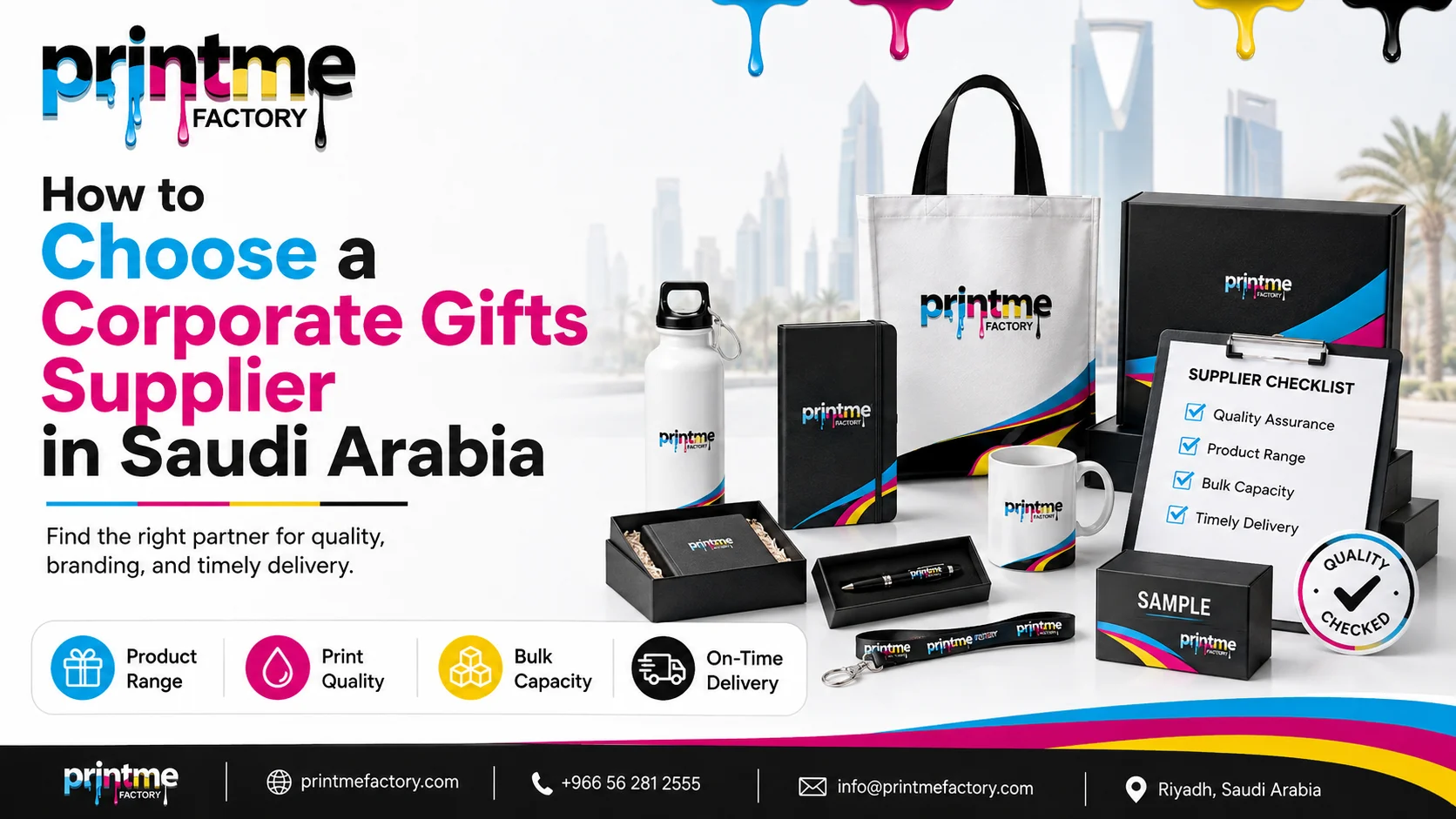
Short Answer: Choose a corporate gifts supplier based on production capacity, branding quality, transparent pricing, delivery reliability, and after-sales support – not simply the lowest unit price. Before placing a bulk order, request a physical sample, confirm the MOQ and production lead time against your actual deadline, and review previous client work or references. In Saudi Arabia, also confirm ZATCA-compliant invoicing and request an itemized quotation covering the products, customization, packaging, and delivery so you understand the complete cost before approving the order.
A corporate gifts program is only ever as good as the supplier behind it. The best product idea in the world falls apart if the branding comes out crooked, the colors are off, or the boxes show up four days after the event they were meant for. Nobody remembers the concept. They remember the mug that arrived late.
Vetting a supplier properly has also gotten more involved, not less. Forrester’s State of Business Buying, 2026 report found the typical B2B purchasing decision now involves 13 internal stakeholders and nine external influencers, up from far fewer just a couple of years ago – procurement decisions that used to get made on a gut feeling and a catalogue PDF now go through genuine scrutiny, and gifting suppliers aren’t exempt from that shift. Saudi Arabia has a wide range of options, from specialist gifting companies to wholesale marketplaces, which makes comparison harder without a clear framework.
Learning how to choose a corporate gifts supplier in Saudi Arabia properly turns a stressful RFQ process into a repeatable checklist. Whether you’re sourcing from a corporate gifts supplier Saudi Arabia teams already trust or vetting someone new, the same eight checks apply every time.
How to Choose a Corporate Gifts Supplier in Saudi Arabia
Step 1 – Define Your Gifting Needs Before You Shortlist Suppliers
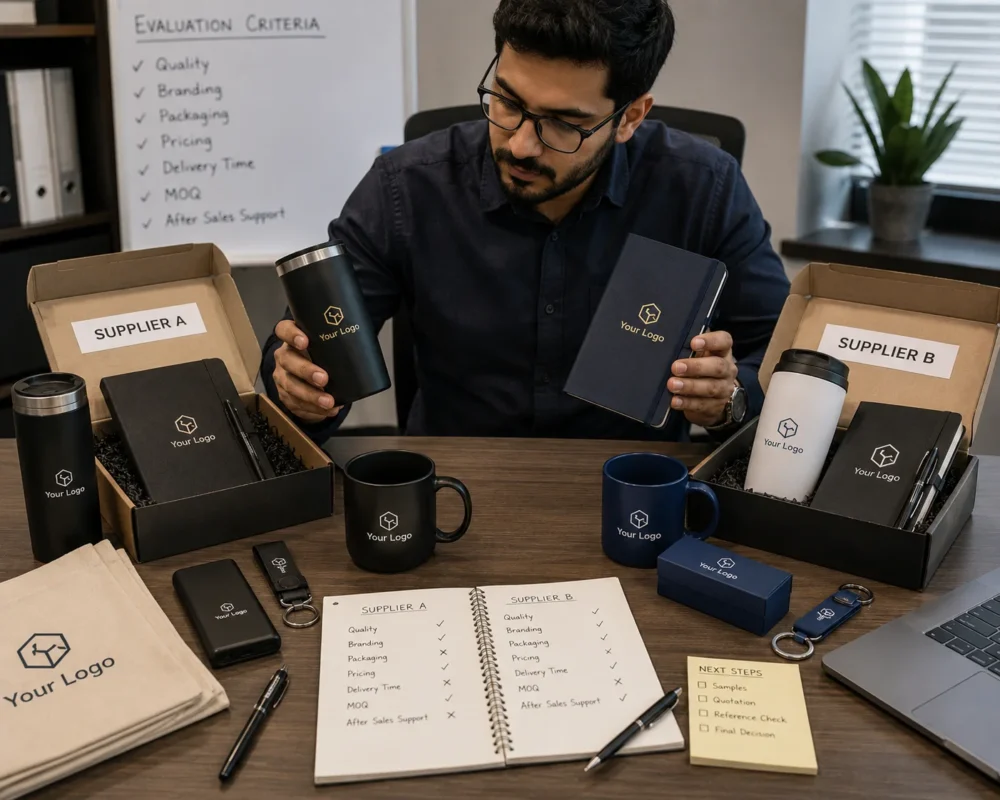
A vague brief gets five different “ballpark” quotes that can’t actually be compared against each other. A clear one gets five quotes you can put side by side. Before contacting anyone, nail down:
- Audience and occasion – clients, employees, event visitors, National Day, onboarding. Each points toward a different budget tier and tone.
- Quantity range, including whether it’s likely to scale up in future cycles.
- Budget band, per unit and total – not just a vague “keep it reasonable.”
- Deadline, with real buffer time built in for approvals and shipping, not just the event date.
- Branding needs – logo only, Arabic-English text, or a full campaign-specific design.
If you’re still unsure whether this is a promotional run or a relationship-driven corporate gift – the Difference Between Promotional and Corporate Gifts changes the entire brief, since the two call for genuinely different suppliers and budgets. Settle that question before you write the request for quotation, not after the quotes come back confusing and impossible to compare.
Step 2 – Check Production Capacity & Category Coverage
Fifty pieces and five thousand pieces are different businesses, and not every supplier who handles one handles the other well. Ask directly whether they can hit your volume without quietly subcontracting the overflow to someone else.
Check whether they cover the categories you actually need – Drinkwares, Apparel and Wearables, Technology Gifts, Gift Sets – in one place, or whether they specialize narrowly and you’ll be juggling multiple vendors for a single order. If you haven’t settled on categories yet, a broader look at Branded Merchandise Ideas for Companies in Saudi Arabia is worth reviewing before the RFQ goes out.
For larger organizations, ask specifically whether output holds steady during peak seasons – Ramadan, National Day, year-end – without quality dropping, and whether they can deliver to several branches on the same date. A supplier who can’t scale becomes the bottleneck exactly when you need them least.
This is also the moment to ask a blunt question most procurement teams skip: what happens to your order if their busiest week of the year and your deadline land in the same seven days? A confident supplier has an actual answer – extra shift capacity, a secondary production line, a partner facility. A supplier who just says “we’ll manage” is telling you they haven’t thought about it.
Step 3 – Evaluate Customization & Branding Quality
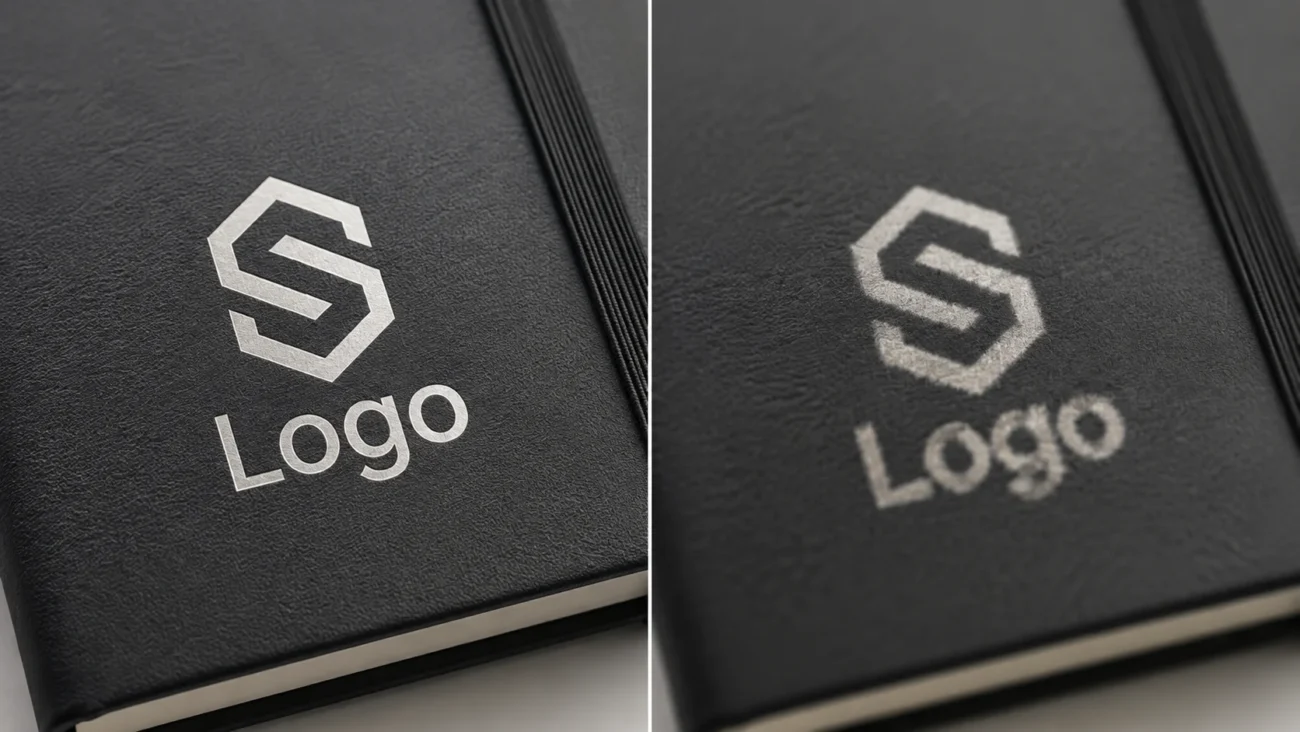
Ask exactly how they brand items – screen printing, pad printing, laser engraving, embroidery, UV or digital print, foil stamping – and which method applies to which product on your list. Request examples of finished work, not catalogue renders (yes, a beautiful catalogue photo tells you nothing about the actual print quality on the item you’ll receive).
Ask about personalization options too: names, Arabic-English text, custom packaging, exact brand color matching. Bilingual branding matters for most KSA corporate and government clients, so confirm it’s a genuine capability, not an afterthought.
Never approve a bulk order based on a digital mock-up alone – always request a physical sample first. A rendered mock-up can look flawless on screen while the real print comes out slightly off-color, blurry at the edges, or printed on a noticeably cheaper material than the render implied. The sample is the only honest test.
Step 4 – Get Full Pricing Transparency
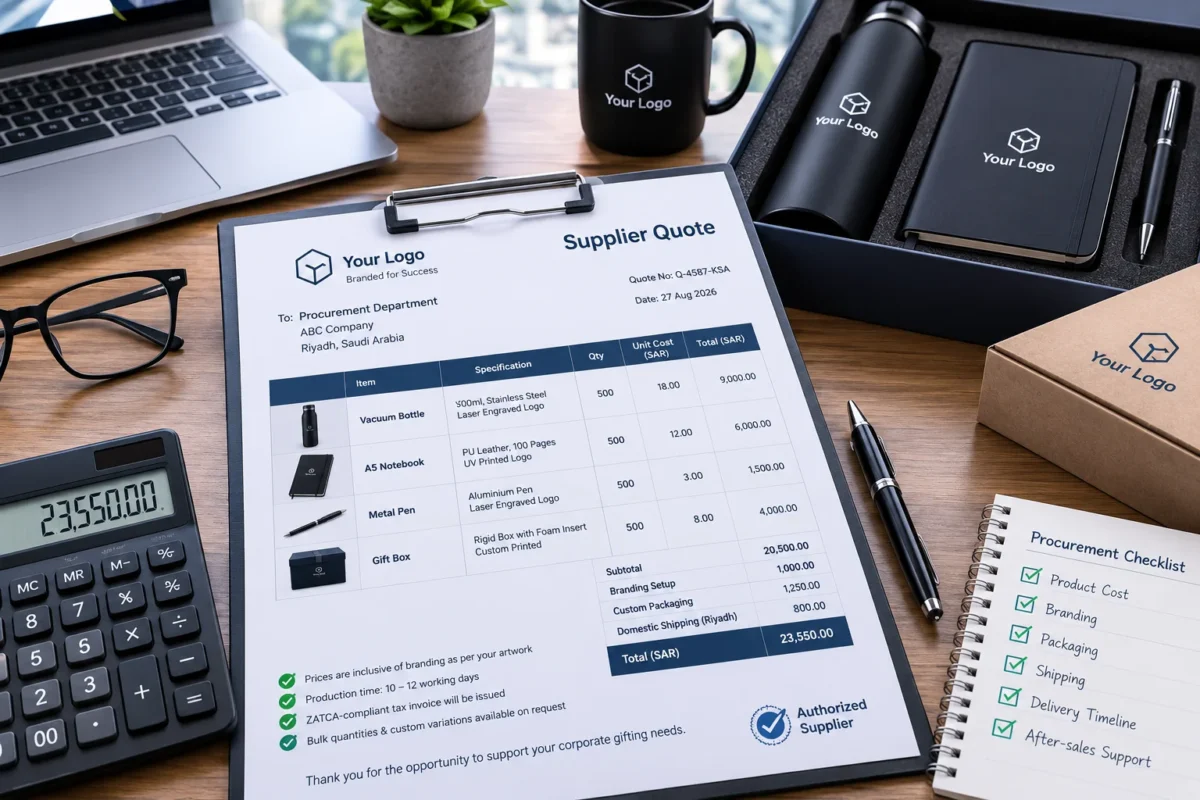
This is where the cheapest quote bites you later. Ask for an itemized quote – product cost, branding or setup fees, packaging, shipping, and VAT with ZATCA-compliant invoicing – rather than one blended number. Compare tiered pricing across quantities (25 / 100 / 500 / 1,000+) to see where the real savings actually kick in, since it’s rarely a straight line.
Watch for the unit-price trap: a low headline number that hides setup costs, rush fees, or packaging charges that only surface at invoice time. What you’re really comparing across suppliers is total cost of ownership – everything it actually costs to get a finished, branded, delivered gift in hand – not the number printed at the top of the quote.
A proper quote should spell out:
- Base product cost per unit at your confirmed quantity.
- Branding setup and per-unit application cost.
- Packaging, whether individual boxes or bulk cartons.
- VAT and ZATCA-compliant invoicing.
- Shipping, broken out by city for multi-location orders.
Clarify payment terms too – deposit versus full payment, bank transfer versus other methods, and confirm pricing is quoted in SAR, not a foreign currency that shifts before the invoice lands.
Step 5 – Confirm Lead Times & Deadline Reliability
Standard branded runs typically take 7-15 working days after artwork approval in KSA, with luxury or imported items needing three weeks or more. Ask the supplier to commit to a realistic production and shipping window with genuine margin built in – not just a “fastest possible” promise that assumes nothing goes wrong.
Ask specifically: “What happens if there’s a delay – do you have backup production or a contingency plan?“ A supplier with a real answer to that question is a different category of partner from one who just repeats the original timeline more confidently. For recurring programs, ask about reorder speed on popular items too, since a fast reorder path saves weeks on every future cycle. For anything time-sensitive, How to Order Bulk Corporate Gifts in KSA Without Last-Minute Surprises walks through how to work backwards from an event date properly.
Step 6 – Check References, Reviews & Past Work
Ask for two or three client references and actually call them – a short script works fine: What was the order size? Did the sample match the bulk run? Was it on time? Any invoicing issues? Most of what you need to know surfaces in the first two answers.
Check independent reviews on Google, LinkedIn, and industry directories for patterns. One bad review is noise. Five similar complaints, all pointing at the same issue, are a signal worth taking seriously. Look for a portfolio or case studies showing work with businesses of a similar size or industry, and government or large-enterprise experience if that’s relevant to your organization.
A supplier who hesitates or stalls when you ask for references is telling you something worth hearing before you commit a five- or six-figure budget, not after. Genuine confidence in past work shows up as an immediate, specific answer – a name, a company, a rough order size – not a vague promise to “send some testimonials over.”

Step 7 – Assess Compliance, Data Security & Ethics
Confirm the supplier issues compliant, audit-ready invoices. Ask how they store and protect recipient names and addresses used for personalized gifts – this matters more than most procurement teams initially assume, especially for larger personalized runs.
For regulated or government-adjacent clients, check anti-bribery and ethical sourcing policies directly, particularly for higher-value gifts where the line between generosity and something murkier gets scrutinized. If sustainability messaging matters to your brand, ask about recycled materials and ethical sourcing credentials specifically – not just whether they carry “eco” products in the catalogue.
None of this is exotic – it’s the same diligence any large purchase order deserves, with a handful of Saudi-specific requirements layered on top. A finance team that recognizes a compliant e-invoice on sight will clear the payment quickly; one seeing an unfamiliar format for the first time will hold it up while they verify it, and that delay lands on the same production timeline as everything else.
Step 8 – Evaluate Communication & After-Sales Support
Notice response time and clarity during the RFQ stage itself – this usually predicts, fairly reliably, how the supplier behaves once you’re a paying client rather than a lead. Ask about their defect or replacement policy before you order, not after a box of misprinted notebooks shows up.
Confirm whether they offer real design support – refining artwork, suggesting products that fit the brief – or just take orders exactly as submitted. For recurring gifting programs, ask whether you’ll get a dedicated account contact or a different person answering the phone every cycle. The second one costs you re-explaining everything, every single time.
A Simple Supplier Scorecard You Can Reuse
Score each shortlisted supplier 1-5 across six factors, and disqualify anyone who fails a hard requirement – no compliant invoicing, for instance – regardless of how well they score everywhere else:
- Production capacity & category range – can they handle your volume and product mix without subcontracting?
- Branding & sample quality – does the physical sample actually match the mock-up?
- Pricing transparency – is the quote itemized with no fees appearing later?
- Lead time reliability – can they hit your date with real margin, not just a best-case promise?
- References & reputation – do past clients confirm consistency, not just one good order?
- Compliance & support – proper invoicing, sound data handling, responsive service?
Common Mistakes When Choosing a Corporate Gifts Supplier
- Choosing based on the lowest unit price without checking what’s included. Do this instead: always compare the full itemized, delivered cost.
- Approving a bulk order from a digital mock-up without ever holding a physical sample. Do this instead: treat the sample as a non-negotiable step, every time, regardless of deadline pressure.
- Ignoring MOQs and expecting small-batch pricing from a bulk-only supplier. Do this instead: confirm MOQs upfront and shortlist suppliers whose minimums actually match your order size.
- Skipping reference calls because the portfolio “looks impressive.” Do this instead: make the calls anyway – a portfolio shows their best day, not their average one.
- Not confirming delivery to every required location before signing off, especially for multi-branch orders. Do this instead: get delivery coverage confirmed in writing, city by city.
FAQs
What should I check first when choosing a corporate gifts supplier in Saudi Arabia?
Start with production capacity, sample quality, and pricing transparency – these three catch most of the suppliers who’ll cause problems later, before you’ve spent any real money.
Should I always request a physical sample before ordering in bulk?
Yes, without exception. A digital mock-up can look perfect while the real print, color, or material differs noticeably once it’s actually in hand.
How do I know if a supplier’s pricing is transparent?
Look for an itemized quote covering product cost, branding, packaging, shipping, and VAT with ZATCA-compliant invoicing – not a single blended number with no breakdown.
What is a reasonable minimum order quantity (MOQ) for corporate gifts in KSA?
Most suppliers start around 50-100 units for branded items, with higher minimums or individual pricing for luxury or highly customized sets.
How important are references and reviews when choosing a supplier?
Very important – a reference call reveals consistency and reliability that a polished portfolio simply can’t show on its own.
Can a supplier deliver to multiple branches on the same day in KSA?
Some larger suppliers can coordinate multi-location delivery across a single date. Confirm this specifically and get it in writing if you have several offices to cover.
What happens if a bulk gift order arrives damaged or misprinted?
A reliable supplier will have a clear defect or replacement policy. Ask about this before ordering, not after a damaged carton shows up with no clear next step.
Do I need to check compliance and invoicing when selecting a supplier?
Yes – confirm ZATCA-compliant e-invoicing and reasonable data handling practices, especially for larger orders or anything tied to a government or regulated client.


2 thoughts on “How to Choose a Corporate Gifts Supplier in Saudi Arabia”
Comments are closed.