
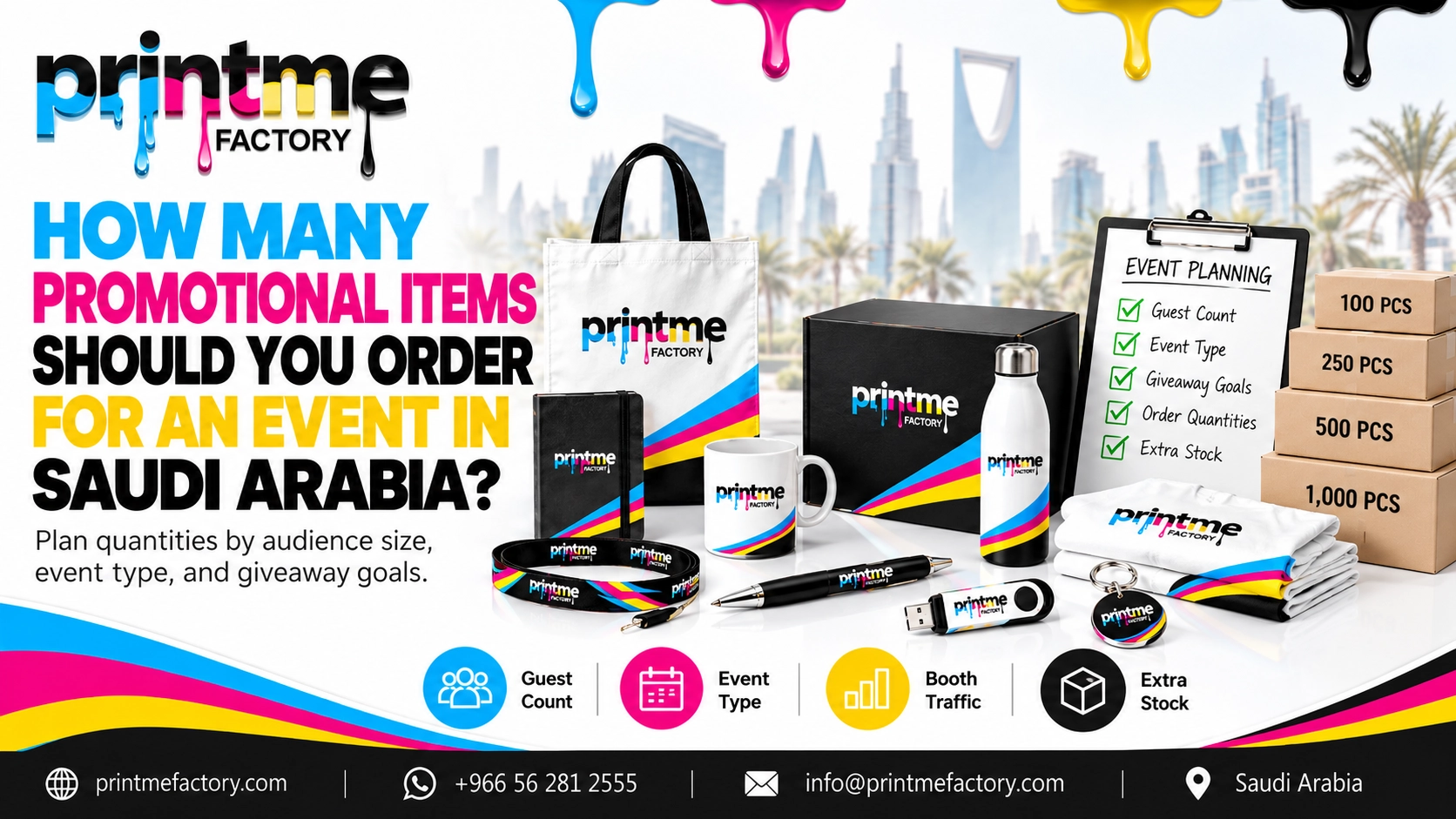
Quick answer: For open-floor exhibitions, order enough giveaways for about 25-30% of your realistic booth traffic – not total event attendance – plus a 15% buffer. For closed-door seminars, order for 110% of your registered guest list to cover walk-ins and last-minute additions. Keep a local Jeddah-based manufacturer on standby for mid-event top-ups, since running out on day two of a multi-day Riyadh show is hard to recover from mid-event.
The most stressful sight for a marketing manager is an empty giveaway table on the morning of day two. Saudi exhibitions run at a scale where guesswork is expensive in both directions – understock, and a booth looks unprepared in front of exactly the buyers who matter most; overstock, and someone has to pay return freight on 3,000 leftover mugs that never left their boxes. The gap between those two outcomes almost always comes down to one thing: whether the order was based on a formula or a feeling.
This article walks through the actual math event professionals use – not a vague rule of thumb, but separate formulas for a closed-door seminar and an open-floor trade show, a tiered allocation model for splitting the budget, and what a Corporate Gifts in Saudi Arabia manufacturer can realistically do when a booth burns through its stock before the event even reaches its final day.
Quick-Reference Quantity Table
| Event Type | Base Formula | Recommended Buffer | Worked Example |
|---|---|---|---|
| Closed-door seminar / private event | Registered guests × 1.10 | Up to 1.15 with speakers, VIPs, staff | 500 guests → 550 (min) to 575 (safer) |
| Open-floor trade show / exhibition | Booth traffic × 25-30% giveaway rate | +15% operational buffer | 5,000 booth visitors → ~1,438 to 1,725 items |
| Any multi-day event | Total quantity ÷ event days | Hold back later-day cartons | 3-day show → release roughly a third per day |
The “Day Two Disaster”: Why Guessing Ruins Exhibition ROI
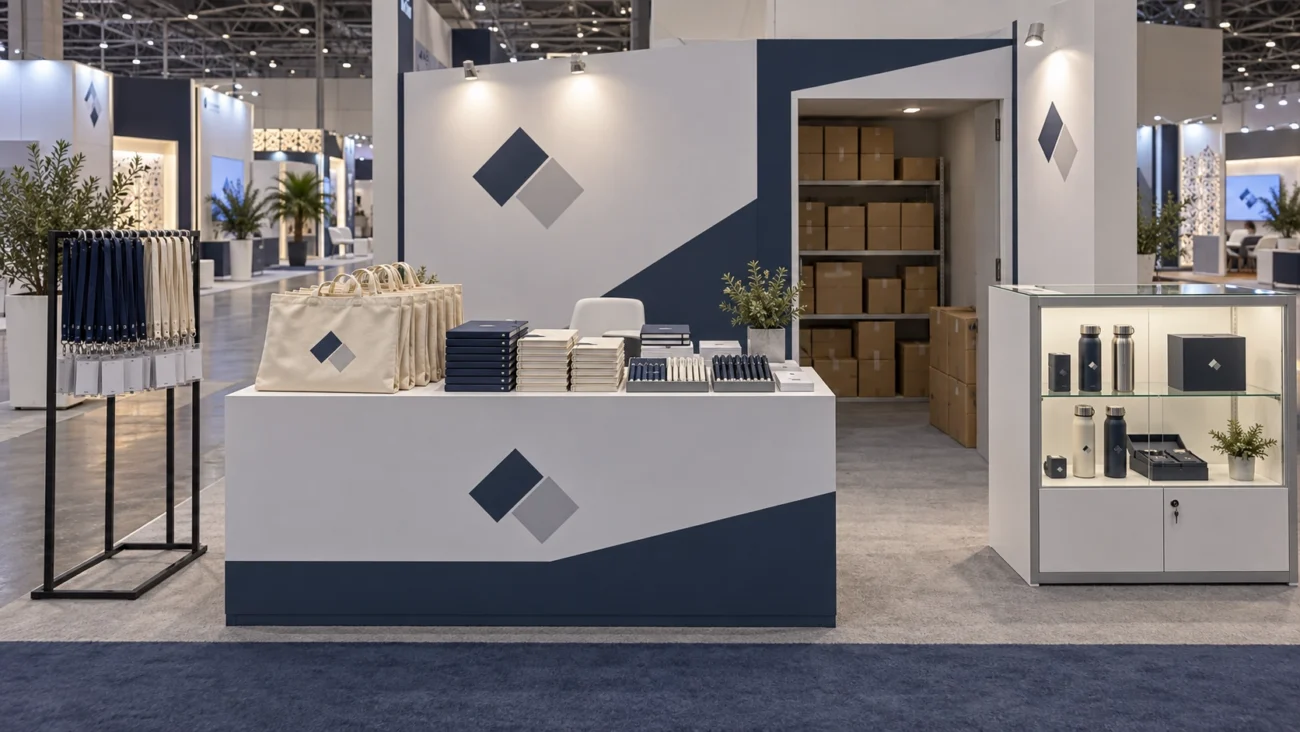
Picture a busy hall at a major Riyadh expo. A booth with an empty giveaway table on day two reads as unprepared, no matter how strong the product behind it is – attendees walking a three-day show remember which stands ran dry, and it is read as a signal about the company’s scale and planning, not bad luck. The opposite failure is just as costly in a different way: heavy items like ceramic mugs or boxed sets that don’t sell through are expensive to ship back, and a company that over-orders ends up paying return freight on stock it will probably never fully use before it goes stale as branded merchandise.
Both failures trace back to the same root cause – using the wrong number as the starting point. Total event attendance is a weak ordering input on its own, because only a fraction of total visitors will ever pass a specific booth. A company in a side hall at a 50,000-person show might realistically see 5,000 of those people walk past its stand, and ordering against the headline 50,000 figure wastes most of the budget on stock that never gets a chance to move.
The math below is specific to events; for the wider question of ordering bulk corporate gifts outside an exhibition context – employee programs, client mailers, onboarding kits – the planning principles overlap, but the quantity formulas here are built for booth traffic and guest lists specifically.
How Many Items for a Closed-Door Seminar or Private Event
For a tightly controlled guest list – a private seminar, a sponsor dinner, an invite-only summit – the formula is simpler than for an open exhibition, because the audience size is already known.
Minimum quantity = Registered guests x 1.10
Safer quantity = Registered guests x 1.15
Treat 110% as the minimum planning baseline for a well-controlled event with a confirmed guest list. Move up toward 115% whenever the event adds variables: multiple speakers who will also want the item, sponsors, staff, last-minute plus-ones, or an RSVP list that has historically run uncertain. These two figures are not contradictory – one is the floor, the other is the safer number once a few extra variables are in play.
For 500 registered guests, the minimum starting quantity is 550. If the event includes several speakers, sponsor representatives, staff, or a guest list with a history of late walk-ins, round up to roughly 575. These are planning examples built on the formula above, not verified attendance statistics for any specific event.
How Many Items for an Open-Floor Trade Show
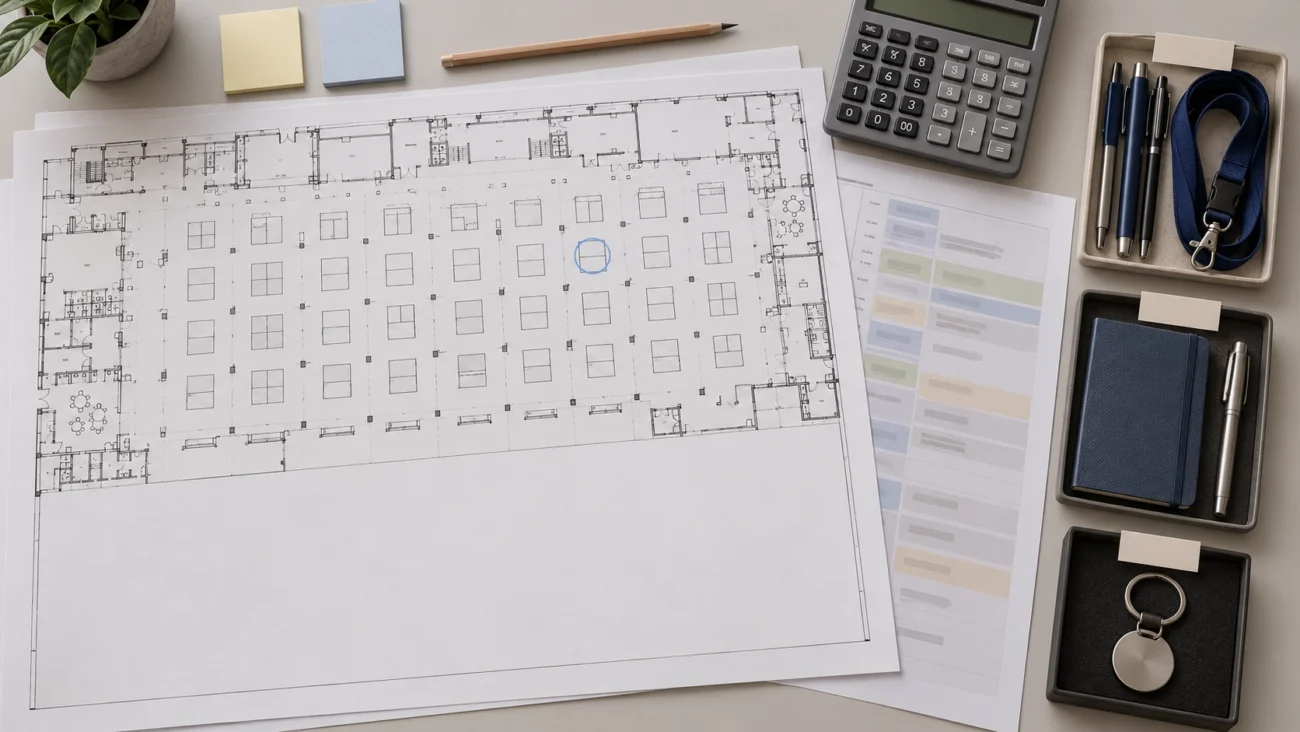
Open exhibitions – the kind where any attendee can walk up to a booth – need a different formula, because the audience is not a fixed list. It’s a flow of foot traffic, and only a portion of that flow actually stops at any one stand.
Quantity = Estimated booth traffic x 25-30% giveaway rate x 1.15 buffer
Walking through the math: if a booth realistically expects 5,000 people to pass it across the event, and roughly 25% to 30% of those visitors take a giveaway, the base quantity is 1,250 to 1,500 items. Add the 15% operational buffer for miscounts, damaged units, and uneven daily demand, and the final order lands around 1,438 to 1,725 items – then round up to whatever carton or pack size the supplier confirms as a practical production multiple.
The 25-30% figure is this article’s practical planning rule for controlled, staff-released distribution – not an independently verified industry-wide statistic, and actual demand varies by booth and event. What should shift that estimate is specific to the booth itself: hall location and entrance proximity, booth size, whether the team is running product demonstrations or scheduled meetings, lead-scanning requirements, daily opening hours and number of event days, how many repeat visitors are likely, which exhibitors are nearby, and whether giveaways sit openly on the counter or are handed out after a conversation.
LEAP is a useful illustration of why total attendance and booth traffic are two different numbers entirely. The organizers’ own 2026 LEAP attendance forecast put the April 2026 edition at over 201,000 visitors across the full event. No single booth in a hall that size sees anywhere close to 201,000 people pass its counter – a realistic share might be a few thousand, depending on hall placement – which is exactly why the formula above starts from estimated booth traffic, not the headline visitor count an organizer publishes.
The 3-Tier Giveaway Strategy
Once the total quantity is set, the next decision is how to split it. A flat pile of identical items wastes the budget on people who were never going to become leads, while VIPs get nothing to signal they were treated differently. A three-tier split solves both problems at once.
| Tier | Share of Planned Volume | Recipient | Suitable Items | Distribution Control |
|---|---|---|---|---|
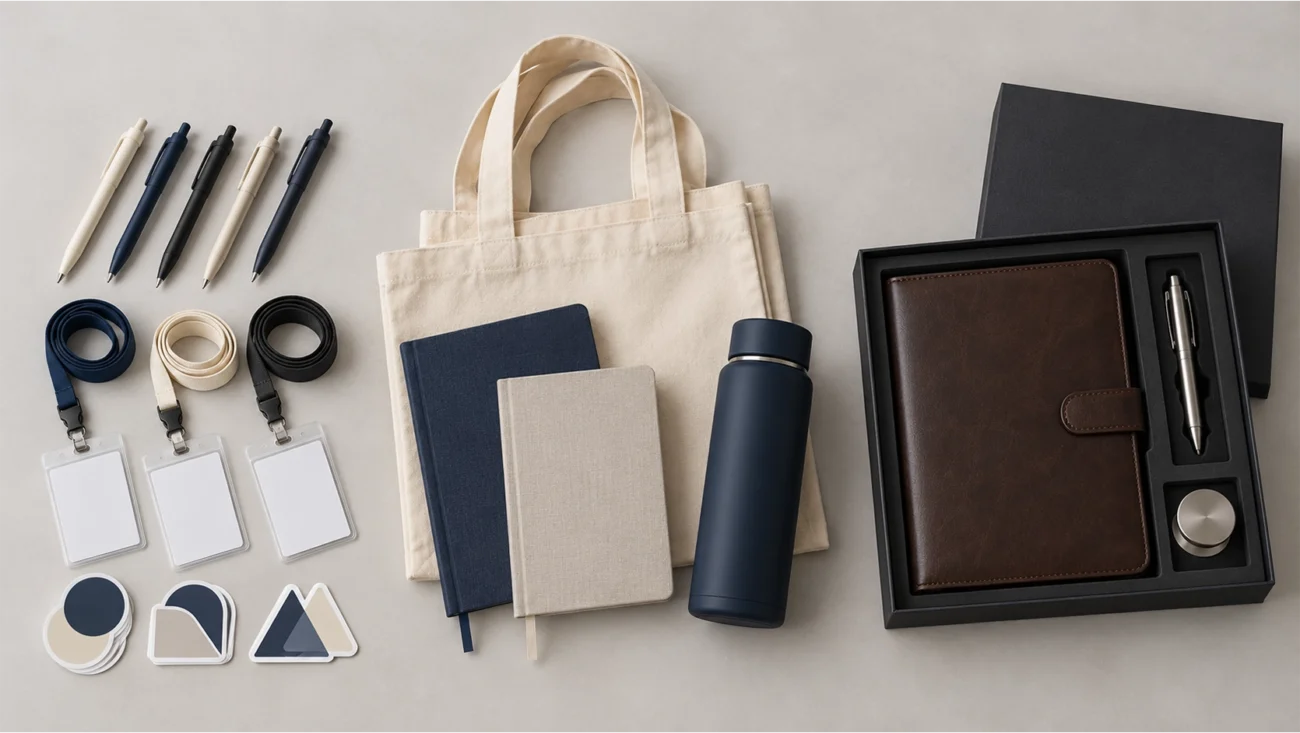
| Tier 1 – Grab-and-Go | ~70% | Any booth visitor, badge-scan only | Pens, lanyards, die-cut stickers | Open counter, self-serve |
| Tier 2 – Conversation Starter | ~25% | Visitors after a lead-capture conversation | Notebooks, tote bags, thermoses | Staff-released, post-conversation |
| Tier 3 – VIP Closer | ~5% | C-level visitors, confirmed buyers, speakers | Premium boxed gifts, engraved items | Kept behind the counter, named approver |
The 70/25/5 split is a starting allocation, not a fixed market standard – adjust it against the event’s actual objective, booth traffic, average lead value, number of scheduled meetings, VIP attendance, item weight and storage space, cost per unit, and whether the event prioritizes broad awareness or qualified sales conversations. A company handing out Tier 1 promotional gifts in Saudi Arabia like branded lanyards moving fast off an open counter should weight the split differently than one running a demo-heavy booth where most interactions are longer and staff-controlled.
Tier 2 benefits from mid-tier, versatile pieces – this is where customized corporate gifts in KSA earn their keep, since lines like notebooks and drinkware work for a wide mix of leads without needing to be as tightly targeted as a VIP item. Tier 3 should stay genuinely scarce and controlled – reserving something like engraved crystal awards for confirmed buyers only works if one named team member, not the whole booth staff, has authority to hand one out.
Daily Inventory Control for Multi-Day Events
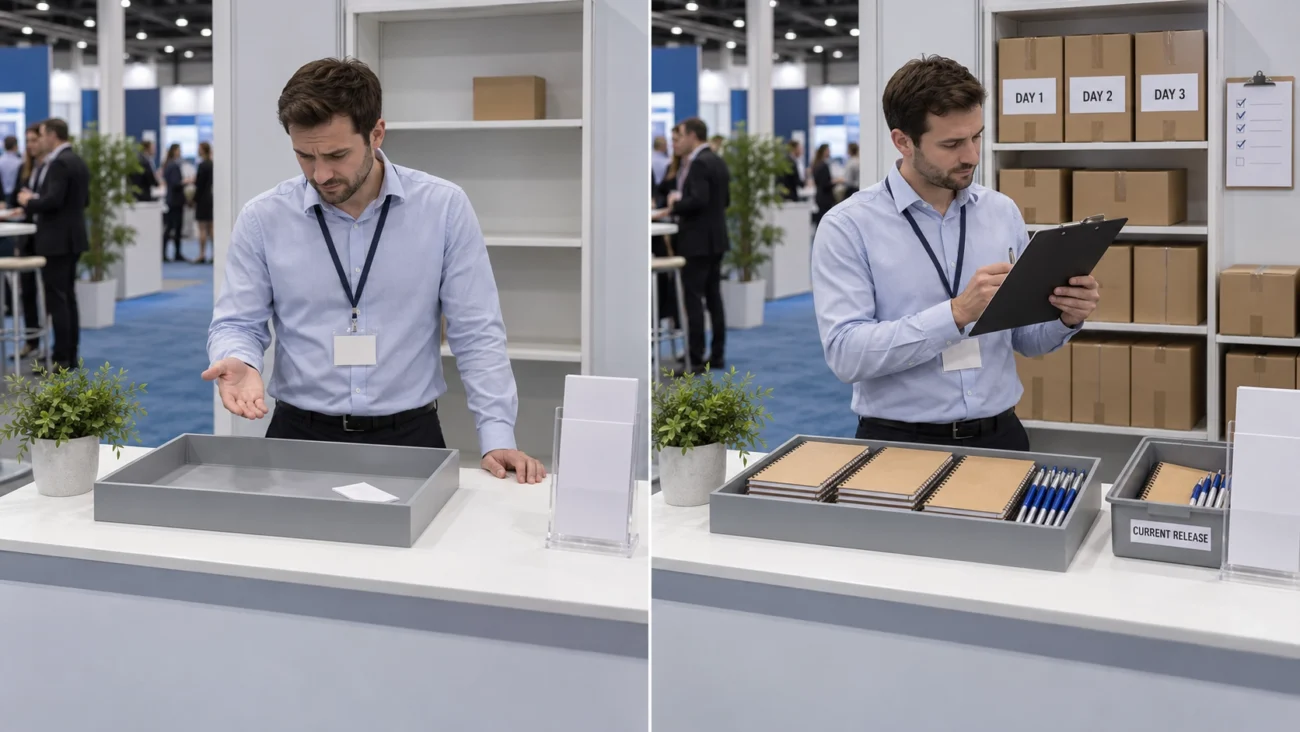
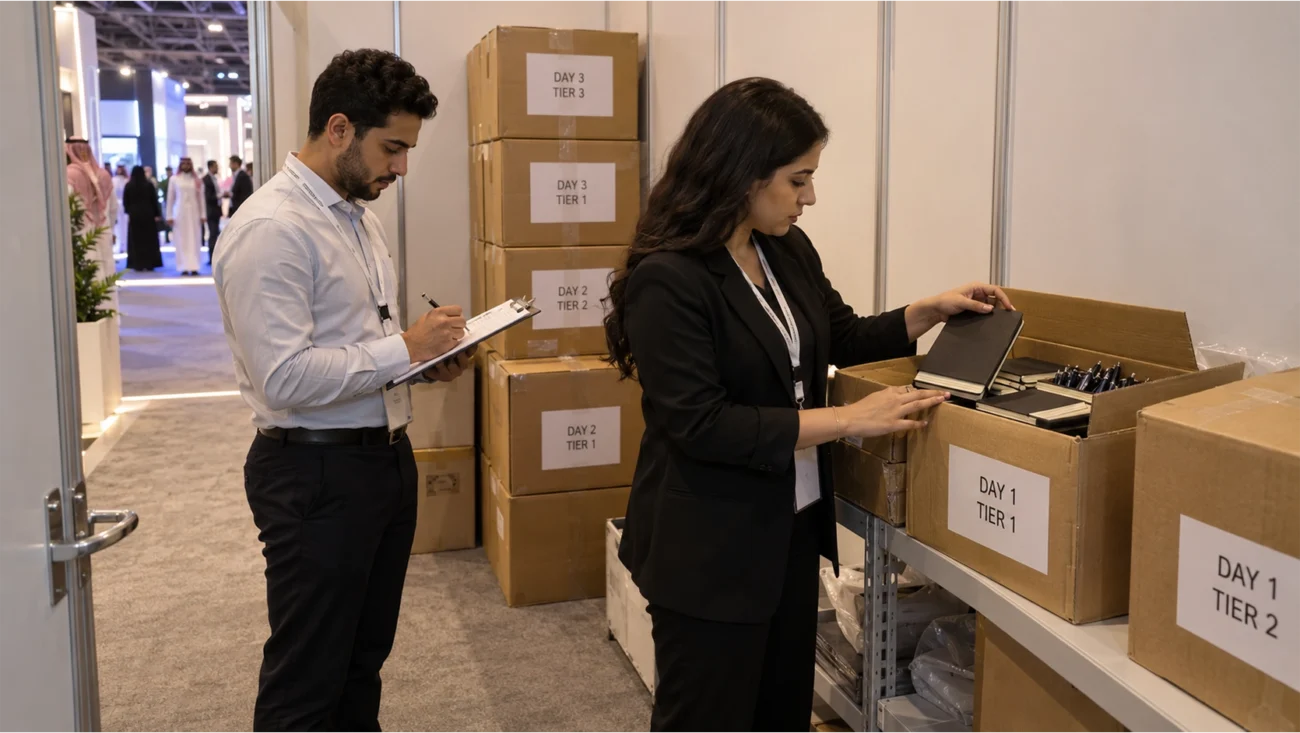
A three-day show needs its stock divided by day before the doors open, not distributed all at once. Divide the final quantity by the number of event days, release roughly that share each morning, and keep later-day cartons sealed and out of sight – a visible full-booth pile on day one invites faster depletion than a controlled release ever would. Recording stock counts at opening, midday, and closing lets a team adjust the next day’s release rate instead of discovering a shortfall only when the table is already bare.
The Local Advantage: Emergency Restocking vs. Overseas Stockouts
If a shipment was ordered from an overseas factory and the booth runs out on day one, there is realistically nothing to be done before the show ends – the replacement stock is still weeks away by sea or days away by air freight, with customs clearance on top. A corporate gifts supplier based in the Kingdom changes that equation, but not unconditionally: restocking overnight only works when the base product is already in local stock, the artwork is print-ready, the branding method is fast (screen printing or UV DTF rather than a slow cure process), the quantity is realistic for an overnight run, and a courier can actually reach the venue before the next morning’s opening.
This is not a claim that every overseas shipment fails, or that a local factory can reproduce anything overnight. A stocked item – a plain tote bag, a notebook, a lanyard, a simple drinkware piece – is realistic to top up fast because the blank already exists; a bespoke gift box, imported electronics, a custom-molded product, or anything individually named is not something any factory, local or not, can conjure from nothing in twelve hours. Treat emergency restocking as a pre-agreed contingency service, not a standing guarantee: agree on rush-order pricing, a maximum top-up quantity, artwork readiness, a production cutoff time, a delivery contact at the venue, loading-dock access, and backup product substitutions before the event opens, not after the counter is already empty.
It’s also worth being precise about what “local” actually means here. In-house branding, printing, kitting, quality control, and domestic dispatch genuinely can run from one Saudi facility – that’s different from claiming every base product was manufactured from raw material inside the Kingdom, which isn’t something every supplier can verify. A supplier that holds stocked blanks domestically and brands them in-house is the realistic version of “emergency restocking,” not a promise to manufacture anything from scratch overnight.
Event scale in Saudi Arabia makes this planning worth the effort. Cityscape Global’s 2026 exhibitor lineup runs to more than 600 exhibitors at the Riyadh Exhibition and Convention Center alone – at that density, a booth team that has not pre-agreed restocking terms with its supplier is competing for the same local production capacity as hundreds of other exhibitors trying to solve the same problem in the same week.
Event Procurement Checklist
- Confirm total event attendance separately from estimated booth traffic – the organizer’s headline number is not your ordering input.
- Calculate quantities by event type, distribution rate, and buffer – using the closed-event or open-floor formula above, not a flat guess.
- Divide inventory by event day rather than releasing the full quantity on day one – and keep later-day cartons sealed.
- Allocate stock across the Grab-and-Go, Conversation Starter, and VIP tiers – before production starts, not after.
- Confirm booth storage capacity, carton dimensions, and replenishment access – a bulky item that doesn’t fit under the counter becomes a liability.
- Approve logos, colors, Arabic-English text, and real product samples – not just a digital mockup.
- Label cartons by event day, product tier, and booth or storage location – so any staff member can find the right box under pressure.
- Name one person responsible for authorizing stock release – especially for Tier 3 VIP items.
- Prepare a daily stock-count sheet – recorded at opening, midday, and closing.
- Confirm venue loading-dock rules, vehicle permits, delivery windows, and receiver contacts – before the event, not during a restock emergency.
- Pre-approve a local emergency-restocking plan and substitute products – including rush pricing and a production cutoff time.
- Decide what happens to leftover stock after the event – reuse it, transfer it to another event, or budget for the loss.
FAQs
How many promotional items do I need for a 500-person corporate event?
550 items covers a 10% minimum buffer for a tightly controlled 500-person guest list. Increase to around 575 when the event includes multiple speakers, staff, sponsors, or a history of late walk-ins and last-minute additions.
What percentage of trade show attendees will actually take a promotional product?
There is no single verified figure that applies to every exhibition. This article uses 25% to 30% of realistic booth traffic as a practical planning rule for controlled, staff-released distribution – actual uptake varies by hall location, booth size, and how openly items are displayed.
Should we keep VIP corporate gifts hidden at our exhibition booth?
Yes. Premium items should stay behind the counter under one authorized team member’s control rather than sitting on open display, where they disappear to casual visitors instead of reaching the confirmed buyers and C-level contacts they were meant for.
What happens if we run out of giveaways during a multi-day event in Riyadh?
Without a pre-agreed local restocking plan, an overseas shipment cannot realistically be replaced before a multi-day show ends. A domestic manufacturer can sometimes top up stocked, simple items overnight, but only when base stock, artwork, and courier access were already confirmed before the event opened.
How much extra buffer stock should we order for event staff and speakers?
Build staff, speakers, and sponsor allowances into the 110% to 115% range for a closed event, rather than treating them as an afterthought on top of the guest count. For an open exhibition, fold this into the overall 15% operational buffer.
Is it cheaper to order one premium item or thousands of cheap giveaways for an expo?
The right answer depends on the event’s objective, not a fixed cost comparison. Mass giveaways maximize reach and brand visibility across casual visitors, while premium items are better reserved for the smaller group of recipients with real relationship or sales value – mixing the two in a tiered split usually outperforms an all-or-nothing approach.
How should we track promotional-item stock during a three-day exhibition?
Record counts at opening, midday, and closing each day, and compare the actual burn rate against the planned daily release. A team that tracks this can slow or speed up the next day’s release instead of finding out about a shortfall only when the counter is already bare.


One thought on “How Many Promotional Items Should You Order for an Event in Saudi Arabia?”
Comments are closed.